
VoIP Phone Systems for Business
A managed VoIP phone system on PIP’s own Australian network — not a carrier resell. HD voice, per-extension pricing, Yealink handsets, and Sydney-based on-site support, integrated with the rest of your IT.
A full VoIP phone system — nothing stripped back.
Everything your old phone system did, on PIP’s own managed network and hosted on PIP’s own infrastructure in a Sydney datacentre. A complete VoIP for business package, not a consumer adapter with a portal.
HD Voice
Crystal-clear calls over PIP’s own managed network — no carrier compression artefacts in the path.
Extensions & hunt groups
Ring groups, department routing and call queuing, configured to the way your team actually works.
IVR / auto-attendant
Press 1 for sales, 2 for support — multi-level menus built and managed by PIP.
Voicemail to email
Missed calls transcribed and emailed to the right inbox — read a message instead of dialling in.
Number porting
Keep your existing business numbers. PIP manages the port end to end, with no loss of service.
Per-extension pricing
Pay per seat, not per minute. A predictable monthly cost rather than a per-call meter running.
Works with Yealink handsets
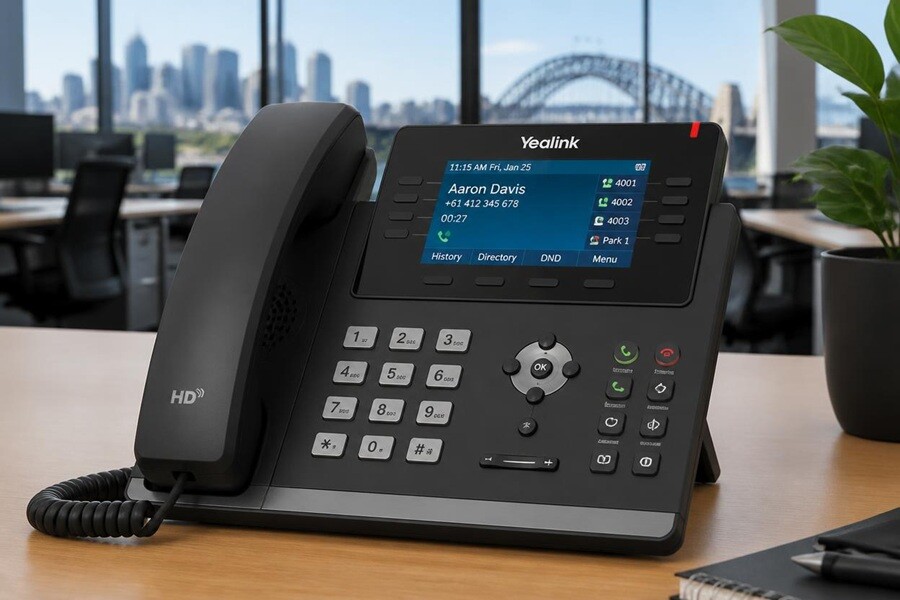
PIP supplies, configures and installs Yealink IP phones matched to the system — or softphones on laptop and mobile.
Australian data
All voice data routes through PIP’s own infrastructure in Sydney. Your calls and recordings stay onshore.
What a pure-play VoIP provider can’t offer.
Most business VoIP in Australia is a portal and a phone number. PIP owns the network, sends technicians on-site, and runs your voice in the same managed stack as the rest of your IT.
PIP owns the network your calls run on
Most VoIP providers buy wholesale capacity from a carrier and resell it. PIP built its own national network in 1995 and runs its own voice platform in a Sydney datacentre. When a call-quality issue arises, PIP doesn’t wait for a carrier to investigate — it can see the path end to end.
On-site when you need it
A pure-play provider can post you a phone and email a config file. PIP’s technicians come on-site across Greater Sydney to install handsets, configure hunt groups, train staff and troubleshoot when something doesn’t work. Remote provisioning is possible; on-site is available.
Voice as part of your managed IT
PIP provides managed IT, internet and voice under one agreement. One support call covers all three. If a staff member’s phone fails the same day their computer plays up, PIP investigates everything in one call — not three tickets to three providers.

Copper going off means a new phone system too.
As the copper PSTN network is progressively retired, the old lines no longer carry voice the way they used to — so a move to the NBN usually means a new voice system alongside the new connection, not just a faster internet plan.
PIP supplies both: the NBN or fibre internet connection and the VoIP phone system that runs on it. Your existing business numbers are ported across, your handsets are pre-configured, and one provider stands behind the whole transition — no gap between the connection and the calls.
One provider for the connection and the calls. Get the NBN transition and the VoIP system handled together.
Talk to PIP about NBN + VoIPFrom assessment to go-live.
VoIP migration can feel daunting. PIP runs it as a managed process, so the switch is a planned event — and you keep the same phone numbers.
Assessment
PIP reviews your current phone system, numbers, call volumes and internet connection — and what existing hardware is worth keeping.
Provision & configure
Extensions set up, hunt groups and IVR configured, and Yealink handsets pre-provisioned to your plan before they arrive on-site.
Install & go live
PIP installs handsets, tests every extension, trains staff and ports your numbers. You keep the same business numbers throughout.
VoIP phone systems for small business.
Small businesses often pay for more lines than they use — a holdover from the days when every staff member needed a dedicated copper number. A VoIP phone system is priced per extension, not per physical line: a team of ten with three inbound numbers doesn’t need ten separate lines, because hunt groups route calls to whoever is free. It’s one of the most cost-effective business VoIP solutions for a growing team.
The real value of a managed system is support. Consumer-grade VoIP adapters bought online work until they don’t, and the troubleshooting is left to you. PIP’s business VoIP Australia-wide service is configured, monitored and supported as part of a managed service — a VoIP phone system Australia-wide businesses can hand off and stop thinking about.
- Businesses migrating from copper PSTN to the NBN that need a phone system for the new connection
- Offices with ageing on-premises PBX hardware due for replacement
- Growing businesses that need to add extensions quickly, without waiting on engineering
- Multi-site businesses wanting internal extension dialling between locations on one system
- Anyone tired of an offshore VoIP support team that can’t send someone on-site
A CBD law firm came to us after their web-only VoIP provider spent three months blaming the internet for a call-quality problem. On site, we found a firmware incompatibility between their handsets and the provider’s platform — a known issue with a known fix the provider had never applied. We ported their numbers, pushed the update, and it was gone that week. Their old provider had a support portal. We had a technician on the desk.Brad Dixon · PIP
Frequently asked questions
What is a VoIP phone system?
A VoIP phone system routes your business calls over your internet connection rather than traditional copper phone lines. IP handsets or softphone apps connect to a hosted PBX that manages extensions, call routing, voicemail and outbound calls. PIP hosts its business VoIP infrastructure on its own hardware and its own network, in a Sydney datacentre.
Do I need to replace my handsets to switch to VoIP?
Not necessarily. If you already have SIP-compatible handsets — Yealink, Cisco or similar — they can often be reconfigured to connect to PIP’s system. PIP assesses your existing hardware first. Most businesses do opt for new Yealink handsets for the jump in call quality, but it isn’t mandatory.
What happens to my existing phone numbers?
Your numbers are ported to PIP’s system and you keep every one of them. PIP manages the porting from your current carrier — most standard Australian business numbers port within 5 to 10 business days, with no loss of service during the transition.
Does VoIP work if my internet goes down?
PIP can configure failover routing that automatically diverts inbound calls to a mobile number or a secondary site during an outage. The hosted PBX itself stays live — only the on-site handsets lose connectivity — so callers still reach you while the circuit is restored.
Can VoIP handle multiple simultaneous calls?
Yes. The number of concurrent calls is determined by your extension plan and internet bandwidth, both of which PIP provisions and manages. For businesses that run their own on-premises PBX, SIP trunking provides the channels instead; to retire the PBX entirely, Cloud PBX is the hosted option.
One provider for VoIP, internet, and IT.
Tell PIP how many extensions you need and what you’re running now, and you’ll get a per-extension quote, porting timelines and handset recommendations — voice, the connection it runs on, and IT support from one team.