
AI Implementation · Custom Software · Business Automation
AI for Business — Strategy, Software & Automation
Artificial intelligence (AI) is genuinely useful for small businesses — but most need help turning AI tools into real business outcomes. PIP delivers both the strategy and the working software: Microsoft Copilot deployment, bespoke AI applications, and business process automation, built by in-house engineers and hosted in Australia.
The capability
What AI can actually do for your business
Most modern AI tools are powered by large language models — the generative AI behind ChatGPT, Microsoft Copilot, and Claude. These large language models read natural language, create content, and create concise summaries faster than any team can. Used well, AI can help a business do far more with the people it already has — and AI can help a small business compete with far larger rivals. Here is where generative AI delivers practical, day-to-day value for small businesses today.
Content & communication
Generative AI helps you create emails, meeting notes, marketing materials, and social media posts in seconds. For teams that produce a lot of written output, it removes hours of routine work while keeping your brand voice consistent.
Data analysis
AI tools sift large datasets and surface patterns a human analyst would take hours to find. Useful across customer records, financial reporting, and inventory — turning raw numbers into actionable insights you can act on.
Customer interactions
AI assistants and chatbots handle routine queries around the clock, freeing staff for the complex conversations that need human judgement and protect the long-term customer relationships your business depends on.
Workflow automation
Repetitive tasks — approvals, data entry, scheduling, document routing — can be automated with AI-connected tools, reducing errors and saving valuable time across your everyday business processes.
Document intelligence
Generative AI reads, classifies, and extracts information from invoices, contracts, and forms. It cuts manual processing dramatically and lets your business put people on the tasks that genuinely need a human.
Decision support
AI tools track market trends across your industry, flag risks, and provide actionable insights — not to make the call, but to help you reach more informed decisions, faster, and find a real competitive advantage.
These are not future promises. Free AI tools and low-cost AI features already sit inside the software most businesses run every day, in almost every industry. The real challenge is no longer access — it is using AI in a way that is consistent, safe, and genuinely connected to how your business works. Using AI well, not merely using AI at all, is what separates the small businesses pulling ahead.
From experiment to everyday tool
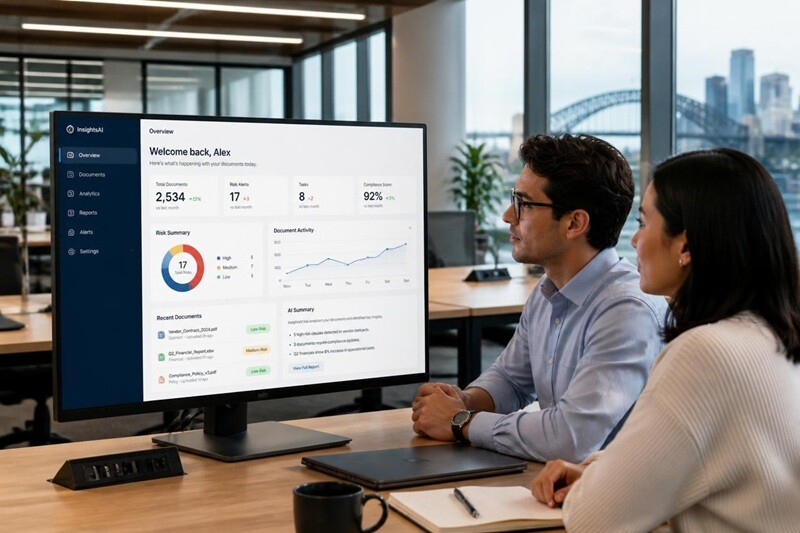
There is a real difference between a one-off prompt and AI built into a workflow. The first saves a person five minutes; the second saves the whole team hours, every week, without anyone thinking about it. That shift — from novelty to infrastructure — is where AI starts paying for itself, and where AI can help most — and it is exactly the work PIP does for its clients.
Getting started
How to start using AI in your business
You do not need a data-science team to begin. The small business owner who gets the most from artificial intelligence starts small and scales what works — and the smart small business owner builds good habits before building dependence. Most small businesses can start this week.
- Identify your business needs first. Decide what you actually want AI to improve — a slow process, a data bottleneck, a stack of repetitive tasks — before you choose a tool.
- Start with simple, low-stakes tasks. Run small experiments where a mistake costs nothing, and prove the value before trusting AI with anything critical.
- Monitor the results. Only scale up the AI tools that deliver demonstrable benefits — measured against real-world data, not the demo.
- Read the privacy and data usage policies. Understand what each AI platform does with your information before you ever input customer data or sensitive records.
- Verify and govern. Check critical information independently and seek professional advice on legal or regulatory matters — AI is a starting point, not the final word.
Get these habits right early and integrating AI tools into the rest of your business becomes far simpler — and far safer.
Where PIP fits
Ways PIP helps you put AI to work
Wherever you are on the curve, there is a path forward for your business. PIP covers the full range — from deploying the AI tools you already pay for, to building software and apps that do not exist yet.
AI for Business
Deploying Microsoft Copilot, AI assistants, and AI solutions across your business systems. We take it from strategy through to implementation — not just tool procurement, but a clear plan for how AI fits your business.
Learn more →Custom Software Development
Bespoke software built by PIP’s in-house engineers, for when off-the-shelf products do not fit how you work.
Learn more →App Development
Mobile and web apps built in-house — iOS, Android, and browser-based — hosted and supported by the team that built them.
Learn more →Business Process Automation
We map the manual, repetitive processes in your business, build the automation, and support it ongoing.
Learn more →The real problem
The gap between AI tools and AI outcomes
Most small businesses have already experimented with artificial intelligence (AI) — a Copilot licence here, ChatGPT for the odd email there, a bit of generative AI used ad hoc. That is a useful start, but it is not a strategy. There is a wide gap between staff using AI ad hoc and AI systems configured for the way your business actually runs.
Generic generative AI tools and clever prompt engineering produce inconsistent results. Configured, integrated AI systems — connected to your data and your workflows — produce repeatable, reliable outcomes. That difference is where competitive advantage comes from: not simply having AI, but using AI better than the business down the road.
AI safety matters here too. Small businesses are responsible for how their AI tools handle customer data and what those tools create in their name. Bridging the gap takes a technical partner who can own strategy, implementation, hosting, and ongoing support — ideally the same provider that already manages your IT environment.
“The clients who get the most value from using AI aren’t the ones who signed up for Copilot first — they’re the ones who mapped their workflows first. We spend as much time understanding the process as we do configuring the tool.”
Brad Dixon, PIP
Why PIP
Why PIP for AI implementation
Plenty of businesses claim AI capability. PIP’s advantages are structural — they come from being an Australian infrastructure provider, not a reseller with a new line on the brochure.
In-house engineers
PIP’s own software development team builds the AI applications and integrations. Not outsourced, not offshore, not contract staff who vanish after go-live.
Australian-hosted
AI applications PIP builds are hosted on PIP’s own infrastructure in an ISO/IEC 27001 certified Sydney datacentre. Your data stays in Australia, under PIP’s direct management — not on an offshore platform you cannot see.
SMB pricing
Enterprise-grade AI systems at a small-business cost. PIP delivers the same standard larger organisations pay substantially more for, scaled to your size.
Single provider
PIP manages the AI application, the hosting, the internet connection, and the wider IT environment. One contract, one support team, one point of accountability.
PIP has been building bespoke applications and tools for clients across a wide range of industry sectors since the 1990s. AI is an extension of work we have done for decades — not a bandwagon.
Using AI responsibly
AI tools are not infallible. They make mistakes — known as “hallucinations” — they can reflect bias, and they handle your information in ways you need to understand. Whatever an artificial intelligence system does, your business wears the result.
That is why responsible use means more than picking the right tool. AI systems need human oversight: someone reviews outputs before they go out, and there is a clear way to stop using a tool if something goes wrong. Understand what each AI platform does with your data before you feed it sensitive client information, and be open with your customers about how you use AI.
PIP includes AI governance basics in every implementation — documented processes for how AI is used, who checks the outputs, and how errors get caught. Clients start with the right habits across the business, not just the right tools.
From the blog
Latest on AI from PIP
Guides, how-tos, and updates on AI for Australian businesses — written by PIP’s engineers.
Common questions
Frequently asked questions
Yes — but the usefulness scales with how well it is implemented. Generic AI tools save time on everyday business content and communication. AI systems configured for your specific business processes — integrated with your data and connected to your workflows — can cut manual work sharply and improve decision quality. The National AI Centre notes that by 2026 the majority of small businesses will have adopted at least one AI solution, so the competitive advantage is already shifting from whether you are using AI to how well you are using AI.
AI tools like Copilot and ChatGPT are general-purpose — useful out of the box, but not connected to your systems. A custom AI solution is built or configured around your business data, your workflows, and your existing software. It is the difference between “AI helped me draft an email” and “AI reads our incoming invoices and routes them automatically.” The first is a handy assistant; the second is genuine business automation.
Both. For many clients, PIP deploys and configures existing platforms — Microsoft Copilot and AI-connected workflow tools. For clients whose needs no off-the-shelf product meets, PIP’s engineers build bespoke AI applications, hosted on PIP’s own Australian infrastructure. Either way, the same team that builds or deploys it also supports it afterwards for your business — so there is one number to call when you need help.
AI implementation without the hype — strategy, software, and automation from one provider
Talk to the team that builds it, hosts it, and supports it. PIP turns AI for business from a buzzword into working software and automated workflows — at a price that makes sense for a small business.