
SIP Trunk Providers Australia
SIP trunks direct from PIP’s own Australian infrastructure — no wholesale carrier in the chain. Keep your existing PBX, move your calls off copper, and deal with the network owner directly.
A SIP trunk built around your call volume.
You already know what SIP is — so here’s exactly what a PIP SIP trunk gives you. Provisioned to your peak call requirement, connected to your existing PBX, and supported by the team that owns the network underneath.
Concurrent call channels
Provisioned to your peak simultaneous call volume and scaled up or down in minutes — no new hardware, no engineer visit.
DDI / DID numbers
Direct inward dialling numbers, either ported across or newly allocated, in any Australian area code regardless of your physical location.
Number porting
Bring your existing business numbers to PIP’s SIP platform. Porting is managed end to end and is transparent to your callers.
Inbound & outbound
Both directions on the same trunk, or split inbound and outbound across separate trunks where your routing calls for it.
Emergency services (000)
Location-registered 000 capability provisioned with the trunk, so emergency calls resolve to the correct address.
Failover & continuity
Configurable failover diverts inbound calls to a mobile or alternate site if your primary internet circuit goes down.
A SIP trunk provider that owns the network.
Most SIP trunk providers in Australia wholesale capacity from a carrier and add a margin. PIP built its own national network in 1995 — your trunk runs on infrastructure PIP owns and operates. As a SIP trunking provider that owns its network, PIP delivers SIP trunk Australia-wide without a wholesale layer in between.
Direct from PIP’s own network
No intermediary carrier, no additional hop in the call path, and no finger-pointing between layers when a quality issue arises. SIP trunks from PIP connect to PIP’s own infrastructure — you deal with the network owner, not a reseller in the middle.
Call quality controlled end to end
When a call-quality problem surfaces, the provider who owns the network can actually diagnose it. Resellers depend on a carrier’s visibility tools and escalation queues. PIP owns the path from your PBX to the PSTN and investigates it directly.
Internet + SIP from one provider
SIP trunk quality depends on internet quality. Take your SIP trunks and your internet from PIP and both sit under one SLA — and PIP can prioritise voice traffic on its own network when it is also your internet provider.
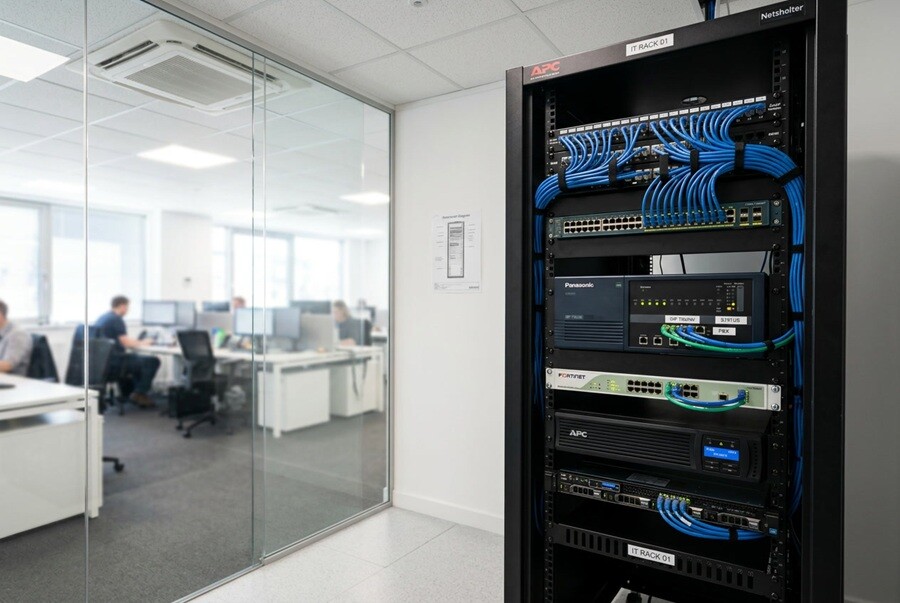
We had a North Shore client running a 12-year-old Panasonic PBX that worked perfectly — the hardware was never the problem, the copper being cut for the NBN was. We configured SIP trunks against their existing system in an afternoon, ported their six business numbers across, and they kept everything: same extensions, same handsets, same hunt group. Their staff didn’t notice a thing had changed.Brad Dixon · PIP
Works with your existing PBX.
PIP’s SIP trunks use standard SIP (RFC 3261) and are compatible with most modern on-premises PBX systems. No proprietary hardware, no forced migration — your existing investment stays in place.
Yealink handsets are supported as SIP endpoints — see business phones for the supported range. If your specific PBX isn’t listed, ask PIP: compatibility can usually be confirmed from a configuration file. Prefer to retire the PBX hardware entirely? PIP’s hosted Cloud PBX is the alternative.
The detail your PBX config needs.
The standards and parameters PIP’s SIP trunks run on — enough to confirm compatibility before you pick up the phone.
| Signalling protocol | SIP (RFC 3261) |
|---|---|
| Audio codecs | G.711 (A-law / μ-law), G.729 |
| DTMF | RFC 2833 |
| Authentication | SIP REGISTER or static IP |
| Transport | UDP, TCP, TLS |
| Concurrent channels | Provisioned to peak call volume, scalable on request |
| Numbering | Ported DIDs or new allocation, any AU area code |
| Emergency calling | Location-registered 000 |
| Network | PIP’s own Australian network — no carrier intermediary |
Frequently asked questions
What is SIP trunking?
SIP trunking is a method of delivering telephone calls over the internet using the Session Initiation Protocol (SIP). It replaces traditional PSTN copper phone lines, allowing an existing on-premises PBX to route calls over your internet connection rather than through a physical line. Each physical line you once had is replaced by a SIP channel with the same call capacity.
What’s the difference between SIP trunking and VoIP?
VoIP (Voice over IP) is the general term for any voice call delivered over the internet. SIP trunking is a specific method: it connects an existing on-premises PBX to the internet using SIP, so a business can keep its existing hardware while retiring copper lines. PIP’s hosted VoIP phone systems replace the PBX hardware entirely; SIP trunks work alongside it.
How many SIP channels do I need?
The number of concurrent channels should match your peak simultaneous call volume. As a general guide, a business with around 20 staff typically needs 4 to 8 channels. PIP reviews your call volume data during the assessment and recommends the right number — you can add channels later without new hardware.
Can I keep my existing phone numbers?
Yes. Existing numbers are ported to PIP’s SIP platform, and the porting process is managed by PIP from end to end. It is transparent to your callers — nothing changes from their side. New DID numbers can also be allocated, usually the same day.
Does SIP trunking work with 3CX?
Yes. PIP’s SIP trunks are tested and compatible with 3CX, and PIP can provide configuration files and support for 3CX installations if required. Asterisk, FreePBX, Cisco CUCM and most other SIP-compliant on-premises PBX systems are also supported.
SIP trunks direct from PIP’s own Australian network.
Tell PIP what PBX you run and your rough call volume, and you’ll get channel recommendations, porting timelines and SIP trunk pricing. As an Australian SIP trunk provider that owns its network, PIP handles the trunk, the internet and the configuration as one job.