
Managed IT · Project Delivery
IT Project Management — Plan, Deliver, Done
Projects delivered, not just managed — from plan to live without surprises. The same team that supports you every day delivers your project.
Most IT projects do not fail because the technology is wrong. They fail because the project is managed badly.
Scope expands without a documented change control process. Timelines slip when team members are not accountable to a single project manager. Stakeholders make conflicting decisions mid-project. The vendor disappears after go-live, leaving internal staff to manage a system they were never briefed on.
PIP provides IT project management services for Sydney businesses that need technology projects delivered — not just quoted. PIP’s IT project managers plan, coordinate, and execute technology projects from initiation to formal closure, with a single point of accountability throughout. The same organisation that manages your ongoing IT is the organisation that runs your project.
What Is IT Project Management?
IT project management is the process of planning, coordinating, and delivering technology projects within defined scope, budget, and timeline constraints. An IT project manager oversees the entire project lifecycle — from defining project goals and securing stakeholder alignment, through planning and execution phases, to monitoring project progress and formal project closure.
IT project management differs from general ongoing IT support in its structure and accountability. Where managed IT support is continuous and reactive, IT project management is scoped, time-bound, and delivery-focused. Every IT project has defined project deliverables, a project plan with task dependencies and milestones, and a formal end point.
Information technology projects have become increasingly complex as businesses run across cloud, on-premise, and hybrid environments simultaneously. Effective IT project management ensures technology initiatives align with business goals, stay within project scope, and are delivered by IT professionals with both the technical depth and the project management discipline to see them through.
What Does an IT Project Manager Do?
An IT project manager defines project scope and objectives, creates a detailed project plan, manages project timelines, coordinates project team members and external vendors, and facilitates communication among stakeholders throughout the project lifecycle. The IT project manager runs the change control process — assessing every new requirement that emerges mid-project for its impact on scope, cost, and timeline before it is accepted or deferred.
PIP’s IT project managers are technically capable IT professionals, not pure project administrators. When a technical constraint surfaces mid-project, the IT project manager can assess and resolve it directly — without escalating to a separate technical team and losing days to handoffs.
IT Projects vs Ongoing IT Support
Ongoing managed IT support is continuous — monitoring, patching, help desk, and maintenance running indefinitely. An IT project is bounded — it has a scope document, a project plan, a defined set of project deliverables, and a closure phase. Server migrations, network infrastructure upgrades, Microsoft 365 migrations, office IT relocations, and infrastructure builds are IT projects. PIP provides both — and the handoff between the two is seamless because the same organisation delivers both.
IT Projects PIP Delivers
- Server migrations
- Microsoft 365 migrations
- Network infrastructure upgrades
- Office IT relocations
- Virtual infrastructure deployment
- Cloud migrations
- OS upgrade programs
- Custom software & integrations
IT Project Management Services PIP Delivers
PIP manages IT projects of all scales — from a single server migration to a full infrastructure rebuild across multiple sites. Every IT project is assigned a dedicated IT project manager who owns delivery from the planning phase through to post-implementation review and handoff.

Server Migrations
Physical and virtual server migrations — planned, tested, and executed with minimal disruption. The IT project manager owns the project plan and confirms system integrity before formal project closure.
Microsoft 365 Migrations
Full Microsoft 365 migration projects covering data migration, user account setup, and legacy system decommission — through to post-migration support handoff.
Network Infrastructure Upgrades
Structured cabling, switch replacements, and firewall upgrades — managed as formal IT projects with a site survey, staged execution, and sign-off testing at each milestone.
Office IT Relocations
Coordinated decommissioning at the old site, transport, and full recommissioning at the new location — network rebuild, infrastructure setup, and day-one connectivity.
Virtual Infrastructure Deployment
VMware and Hyper-V virtualisation projects — from architecture design through deployment and testing. High-availability infrastructure for businesses where hardware failure was causing unplanned downtime.
Cloud Migrations
Moving workloads from on-premise to cloud, or between cloud environments — with a documented rollback position at every stage so the project does not put the business at risk during transition.
OS Upgrade Programs
Staged OS upgrade and device replacement programs — inventoried, assessed, planned, and delivered without disrupting business operations.
Custom Software & Integration Projects
API integrations, custom application deployments, and platform integration projects — where both technical expertise and structured project management are required.
How PIP Manages an IT Project
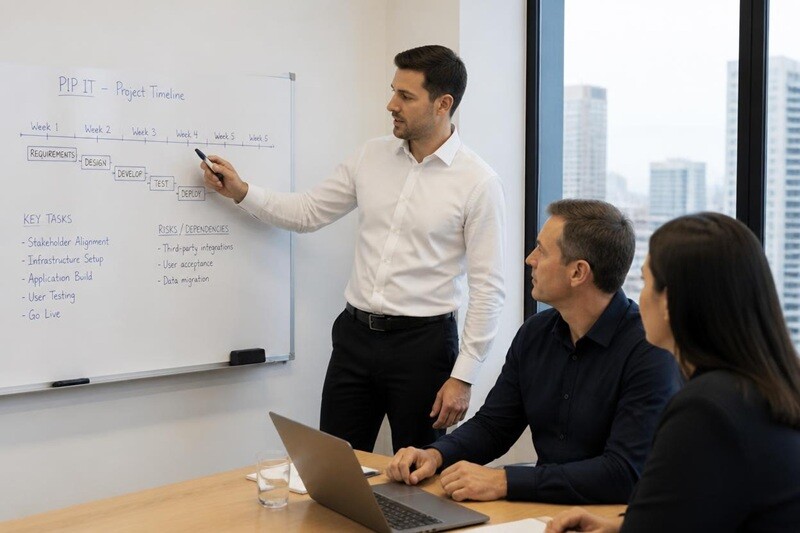
PIP’s IT project management process follows a structured project lifecycle — five defined phases that take every IT project from initiation to documented closure. Each phase has clear outputs, accountabilities, and sign-off criteria before the project team moves forward.
Initiation
Defines the project need and confirms project scope, project goals, and stakeholder alignment. The IT project manager produces a project brief documenting what is in scope, what is explicitly out of scope, and what successful project outcomes look like. No project begins execution without a signed-off initiation document.
Planning
Produces the project plan — covering the work breakdown structure, task dependencies, resource allocation, project milestones, a realistic timeline, budget parameters, and a risk management register. The communications plan is also set: who receives updates, at what frequency, and through which channel.
Execution
The project team carries out the planned work. The IT project manager coordinates project team members, manages vendor relationships, and runs the change control process to prevent scope creep from entering the project without a formal decision.
Monitoring
Active monitoring of project progress, risk register, budget, and timeline runs continuously throughout execution. The IT project manager tracks progress against project milestones, identifies deviations early, and adjusts resourcing or sequencing before small issues become project-level problems.
Closure
Final delivery sign-off, post-implementation testing, documentation handover, and a project post-mortem to capture lessons learned. The IT project manager ensures all project deliverables are accepted and the project is formally closed before handoff to ongoing managed IT support.
What prevents project failure
IT Project Management Across Greater Sydney
IT Project Management Methodologies
No single project management approach fits every IT project. PIP’s IT project managers select and adapt their methodology based on project context. The Project Management Institute’s frameworks inform PIP’s approach, and project management professional standards are applied across every engagement.
Waterfall
A traditional linear approach where each project phase must be completed and signed off before the next begins. Suits IT projects with clearly defined project requirements and minimal expected change — hardware rollouts, structured infrastructure upgrades, and network projects where project scope is fixed from the start. Waterfall’s strength is its predictability: each project milestone is visible and the project plan is stable.
Agile Project Management
Built on iterative development and regular stakeholder collaboration. Agile works well for software development projects and complex IT projects where project requirements evolve as the team learns more. Scrum breaks agile projects into short fixed-length sprints. Kanban boards provide real-time visibility of task stages and project progress. PIP applies agile project management approaches where iterative delivery is genuinely more appropriate — not as a default methodology.
Hybrid Approaches
Most real-world IT projects combine elements of both. The infrastructure layer is planned and delivered linearly with a fixed project plan. The configuration or software layer is managed with more iterative flexibility, particularly when the full scope of requirements only becomes clear during project execution. PIP’s IT project managers select the approach that fits the actual work — not the approach that produces the cleanest Gantt chart.
Change Control
Every IT project requires a documented change control process. When new requirements emerge mid-project, change control ensures they are assessed for their impact on project scope, cost, and timeline before being accepted. IT projects without a documented change control process experience scope creep — the gradual expansion of project scope that erodes timelines and budgets without any single identifiable decision. Scope creep is the most common cause of IT project overruns, and it is almost entirely preventable with a disciplined project management process.
IT Projects PIP Has Delivered
PIP’s IT project managers have delivered complex IT projects across a range of Sydney businesses — cloud migrations, infrastructure builds, Microsoft 365 deployments, and custom integration projects. The following are representative examples from PIP’s project history, anonymised.
Microsoft 365 Migration
A mid-sized business with file storage spread across multiple platforms. PIP managed the full migration to Microsoft 365 — restructuring data into a logical repository and removing legacy synchronisation processes.
Secure API Integration
A professional education provider required integration between internal systems and an external learning management platform. PIP designed and managed the integration project, implementing granular permission controls that restored data sovereignty.
High-Availability Virtual Infrastructure
A business at risk of downtime from hardware failure. PIP managed the deployment of virtualised infrastructure across multiple hosts with automatic workload balancing and failover.
OS Upgrade Program
A business running an unsupported desktop OS across an ageing device fleet. PIP managed a full device audit, hardware compatibility assessment, and staged upgrade and replacement program.
The most expensive IT project we see is the one that was not managed. The server migration that took four times as long as it should have because there was no project plan, no change control process, and no single person accountable for delivery. We have taken over IT projects mid-stream that had no scope document and no milestone schedule. Getting a failed project back on track is always more expensive than managing it properly from day one — and the business has already paid twice.
Why PIP for IT Project Management in Sydney?
Technical depth behind the project manager
PIP’s IT project managers are not pure project administrators — they are technically capable IT professionals who understand the infrastructure they are managing. When a technical constraint surfaces mid-project, the IT project manager can assess it directly, without waiting on a separate technical escalation. That combination of project management discipline and technical understanding is what keeps complex projects moving.
Single provider — project and ongoing support
When PIP delivers an IT project, the handoff to ongoing managed support is seamless. The IT project manager and the managed services team are the same organisation. There is no gap between project delivery and business-as-usual support.
Managed IT services →
Owned infrastructure for project delivery
PIP owns its national internet network, its hosting platforms, and its telephony infrastructure. For IT projects that involve cloud migrations, hosted environments, or connectivity infrastructure, PIP can deliver across every layer — not just the parts within arm’s reach of a reseller.
Formal project management process
Every PIP IT project follows a structured project lifecycle — initiation, planning, execution, monitoring, and closure. Project scope is defined before any work begins. A change control process governs what enters the project. This is not described in the project proposal — it is what actually happens.
Sydney-based project delivery
IT projects that require on-site work — office IT relocations, server room builds, network infrastructure upgrades — are managed and delivered by PIP’s Sydney-based team. On-site project management and execution across all of Greater Sydney.
On-site IT support →
Frequently Asked Questions
IT project management is the discipline of planning, coordinating, and delivering technology projects to a defined scope, timeline, and budget. An IT project manager owns the full project lifecycle — from defining project goals, through the planning phase, execution phase, and monitoring, to formal project closure. IT project management services are engaged when a technology initiative is too complex, too time-critical, or too operationally disruptive to be managed informally alongside standard IT support. Effective IT project management ensures technology projects align with business goals and reach successful completion without scope creep, timeline blowouts, or undocumented outcomes.
IT projects cover a wide range of technology initiatives. Common examples include: server migrations and virtual infrastructure deployments, Microsoft 365 migrations and cloud platform transitions, network infrastructure upgrades and structured cabling, office IT relocations, operating system upgrade programs across a device fleet, custom software development and API integration projects, and high-availability infrastructure builds. What makes these IT projects — rather than standard managed IT support — is that they have a defined project scope, a project plan with milestones, project deliverables, and a formal closure point.
The IT project management process follows five defined phases. Initiation establishes project scope, project goals, and stakeholder alignment. Planning produces the project plan — covering the work breakdown structure, task dependencies, resource allocation, project timeline, risk management, and communications plan. Execution is when the project team carries out the planned work, governed by the change control process to prevent scope creep. Monitoring tracks project progress against milestones and adjusts for deviations before they compound. Closure finalises project deliverables, confirms sign-off, and documents lessons learned. IT project managers certified by the Project Management Institute (PMI) — including those holding the Project Management Professional (PMP) qualification — follow this project lifecycle as standard practice.
The five basics of project management are scope, time, cost, quality, and risk. Scope defines what the project will and will not deliver — and scope creep is what happens when scope expands without going through the change control process. Time sets the project timeline and tracks progress against project milestones. Cost establishes the budget and monitors resource allocation throughout the execution phase. Quality defines the standard to which project deliverables must be produced. Risk management identifies potential problems early, assesses their likelihood and impact, and plans how to manage or mitigate them before they affect the project. Effective IT project managers balance all five constraints simultaneously.
Ready to Get Your IT Project Moving?
PIP’s IT project management team plans, coordinates, and delivers technology projects across Greater Sydney — from a single server migration to a full infrastructure rebuild. Whether you need a dedicated IT project manager for a defined engagement, or IT project management as part of your managed services agreement, start with a conversation.