
Hosted Cloud PBX for Business — Hosted on PIP’s Australian Infrastructure
A hosted PBX that runs on PIP’s own infrastructure — extensions, IVR, call recording and voicemail, fully managed, with no hardware to run on site.
What is a cloud PBX?
Before comparing cloud PBX providers, it helps to be clear on what a hosted PBX actually is, how it differs from a traditional phone system, and where VoIP fits in.
What is a cloud PBX?
A cloud PBX (Private Branch Exchange) is a business phone system hosted in a datacentre rather than on hardware at your premises. Call routing, extensions, IVR, messaging and call flows are all managed remotely over the internet. Staff make and receive calls on IP phones, a desktop softphone, or a mobile app on Android and iOS — the hardware itself sits at the provider’s end, not in your office.
How does a cloud PBX differ from a traditional PBX?
A traditional on-premises PBX sits in your server room and needs an upfront hardware purchase, ongoing maintenance and upgrades as the business grows. A cloud PBX — also called a hosted PBX system or a virtual PBX — moves all of that to the provider’s infrastructure. There is no hardware to buy and no hardware lifecycle to manage; the cloud carries the load instead.
Is cloud PBX the same as VoIP?
VoIP — Voice over Internet Protocol — is the technology that carries calls over the internet. A cloud PBX is a phone system architecture that uses VoIP to deliver calls. Every hosted phone system uses VoIP, but not every VoIP setup is a cloud PBX. It is the complete phone system — extensions, routing, IVR, voicemail — that happens to use VoIP as its transport.
What is a cloud PBX for small business?
For a small business, a cloud PBX replaces a traditional system without the upfront hardware cost. Monthly fees depend on the number of users rather than a large capital purchase — cloud PBX can cost as low as $25 per user per month. There are no hardware setup costs, and scaling up is as simple as adding users when the team grows.
Every feature of a complete business phone system.
PIP’s hosted platform delivers the full feature set and feature access buyers compare across providers — call handling, routing, recording, mobility and collaboration — all managed for you. Each feature below is part of the standard hosted PBX platform.
Extensions & DDI numbers
Each user gets an extension and an optional direct inward dialling (DDI) phone number, so incoming calls reach the right person without going through reception.
Auto attendant / IVR
A multi-level attendant greets callers and routes their calls to the right department. Press 1 for sales, 2 for support — or natural-language routing where the system detects intent. PIP configures and manages how each call routes.
Hunt groups & ring group
Route incoming calls to a group of extensions at once or in sequence. A hunt group suits reception, sales or support teams where any member can take the call.
Call queues
Hold callers in call queues with hold music or periodic announcements instead of a busy signal. Set the maximum queue depth and overflow routing for when waiting times climb.
Call recording
Optional per-extension or system-wide call recording for compliance, training and quality review, with recordings stored on PIP’s own infrastructure in Sydney and accessed via a secure web portal.
Voicemail to email
Messages are transcribed and delivered to the right inbox, so staff read a missed message rather than dialling in. Cloud PBX message handling works with your existing email — no extra software.
Caller ID management
Set outbound caller ID per extension or department — present one main number to every outgoing call, or allow direct DDI caller ID for individual staff.
Call flows & routing rules
Build call routing with time-based rules (business hours vs after-hours), area code logic and fallback paths. PIP configures call flows to match how your business actually operates.
Mobile app & softphone
Extensions ring on Yealink IP phones, a desktop softphone and a mobile app on Android and iOS at the same time, so staff use the same phone system from any of their devices.
Video calls & video conferencing
Video calls run on the softphone and app clients, with outbound video conferencing for internal calls — no separate conferencing subscription required.
Microsoft Teams integration
The cloud PBX integrates with Microsoft Teams via Direct Routing, so MS Teams users make and receive calls through PIP’s SIP infrastructure — no separate Teams calling plan needed.
Conference bridges
Dedicated audio conference bridges for team meetings, so callers connect and team calls run without a third-party conferencing service.
Contact center features
For higher call volumes, PIP configures contact center features — supervisor monitoring, call whisper, barge-in, and reporting and analytics on call queues — to lift customer experience.
High availability & redundancy
The platform runs on redundant PIP-owned hardware in a Sydney datacentre with a 99.9% uptime guarantee. A 24 Mbps connection supports at least 300 simultaneous calls, and failover keeps incoming and outgoing calls flowing if a primary path fails.
How calls route through PIP’s cloud PBX
A call flow is the path calls take from the moment they arrive to the moment they are answered or sent to a message box. PIP builds each call flow around your structure rather than a generic default.
Inbound call flow
When calls arrive, the attendant greets each caller, the menu selection or detected intent picks a path, calls route to an extension or hunt group, and unanswered calls drop to a transcribed message.
Time-based routing
Business-hours and after-hours call flows differ. During the day calls reach the team; after hours they route to an on-call number, a message service, or a message box — automatically, by the clock.
Overflow & failover call flows
When extensions are busy or unavailable, calls follow a configured fallback — another team, a queue, or a message box — so callers are never left waiting on calls that go nowhere on a path that goes nowhere.
Geographic routing
Where it matters, calls route differently based on the caller’s area code or caller ID — useful for businesses that run distinct teams or numbers across regions.
Cloud PBX for remote and home workers
A cloud PBX is designed for remote or hybrid work — it lets a business maintain a professional presence wherever staff are working.
Work from anywhere
Staff take calls on the same extension whether they are in the office, at home, or on the road. Remote staff and home workers stay connected to the same phone system as everyone else, with no second setup to manage.
Mobile app
Android and iOS apps bring full extension functionality to staff mobile devices. Incoming calls ring the desk phone and a personal handset together, and outgoing calls show the business caller ID rather than a personal number.
Softphone
A desktop softphone gives laptop users full feature access on their own devices — transfers, messages and conference bridges — without a physical desk phone on the desk.
Stay connected across sites
Multi-site businesses run one cloud PBX with extensions across every location. Internal dialling between sites uses extension numbers, so inter-office calls carry no external call charges.
Built to handle your calls — and supported when it matters
A hosted phone system has to carry real call volume without dropping calls. PIP’s hosted PBX platform handles hundreds of simultaneous calls, so the phones keep answering calls at the busiest moments of the day rather than turning callers away.
Capacity that scales with your users
A single 24 Mbps internet connection supports at least 300 simultaneous calls — far more than most offices ever place at once. Incoming calls, outgoing calls and internal calls between users all run across the same service. As you add users the service scales without new hardware, and each user connects from any of their own devices — desk phones, mobiles and laptop softphones — making and receiving calls on the same phone number range. Hundreds of concurrent calls are handled without the system straining.
Reliability that keeps calls answered
With a 99.9% uptime guarantee and redundant hardware, queued calls wait in line rather than failing, and overflow calls route to a fallback so missed calls don’t turn into lost customers. The service keeps answering calls when customers are trying to reach you — incoming and outgoing calls continue even if a primary path fails, which is the whole point of a business phone system.
Security and access
Calls, recordings and account access are protected with role-based access controls and encryption in transit. Voice traffic stays on PIP’s own infrastructure in Sydney, and admin access to the system is restricted and logged. Security is handled as part of the managed service, not left to customers to configure — a level of security that matters most to medical, legal and financial customers.
One support team for the whole service
When something needs attention, support comes from the team that runs the platform — not an offshore queue. PIP’s support covers the hosted PBX, the internet connection and the IP phones together, so customers raise one request and one provider owns the outcome as a single support service. That single line of support is the difference between a phone service and a dependable service.
Cloud PBX as part of your unified communications stack
A hosted phone system is increasingly one component of a unified communications environment — sitting alongside messaging, video conferencing and collaboration tools rather than standing alone. The phone system becomes the telephony layer of a broader tech stack.
PIP’s platform integrates with Teams via Direct Routing, with email through message transcription, and with other systems via SIP trunk and standard APIs where supported. For businesses that want voice and video in one place, the platform can serve as the underlying telephony layer for a wider unified communications deployment — calls handled by PIP, the rest of the stack however the business prefers.
Why hosted on PIP’s own infrastructure
Most cloud PBX providers in Australia resell a wholesale platform. PIP is not a new provider reselling someone else’s system — it has operated its own infrastructure since 1995.
Not a reseller’s platform
Most cloud PBX providers resell a carrier or international telephony platform. PIP’s hosted PBX system runs on PIP’s own hardware and PIP’s own network, in an ISO/IEC 27001 certified Sydney datacentre. When a call-quality issue arises, PIP investigates directly rather than waiting on a platform provider.
Your voice data stays in Australia
Calls and recordings route through PIP’s own infrastructure in Sydney — not a hyperscaler, not an offshore carrier hub. That matters for regulated industries where data residency and security are conditions of doing business: medical, legal and financial.
One provider for PBX, internet and IT
PIP provides the cloud PBX, the internet connection it runs on, and a fully managed IT service around it. If call quality dips when the office internet is under load, one provider investigates and resolves both — no separate tickets to separate providers, and one point of support.

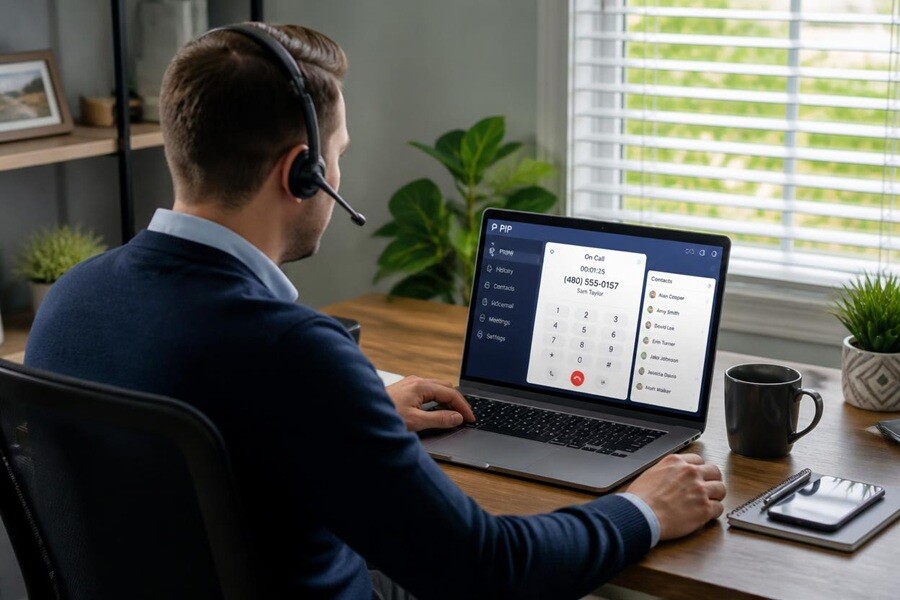
Cloud PBX vs traditional on-premises PBX
On-premises hardware still suits some businesses. This is a factual comparison, not a dismissal of a traditional phone system.
| Cloud PBX | Traditional on-premises PBX | |
|---|---|---|
| Hardware cost | No physical hardware to purchase | Significant upfront cost |
| Maintenance | PIP’s responsibility | The customer’s or an IT provider’s responsibility |
| Scalability | Add users instantly | Limited by hardware capacity |
| Redundancy | Datacentre high availability | Depends on the server-room setup |
| Service level agreement | PIP’s SLA covers the whole system | Separate hardware and software SLAs |
| Remote workers | Supported natively | Requires extra configuration |
| Phone lines | No copper lines — runs over your internet connection | Often still tied to traditional phone lines or SIP trunks |
| Upfront cost | From $25/user/month, no hardware purchase | Hardware purchase plus ongoing maintenance |
Cloud PBX pricing — what to expect
Cloud PBX services often include no upfront hardware costs — the system runs on PIP’s infrastructure, not on equipment your business buys. That removes the largest single line item of a traditional phone system from day one.
Monthly fees typically depend on the number of users. Cloud PBX can cost as low as $25 per user per month for a basic plan; larger deployments with call recording, contact center features or video conferencing cost more. The minimum cost for a small team is therefore modest, and you only pay for the users you have.
Setup costs may apply for larger cloud PBX systems — particularly where phone number porting, complex call flows or multi-site configuration is involved. PIP provides a quoted setup cost upfront rather than a surprise on the invoice. Some providers offer unlimited calls for a flat monthly fee; PIP’s cloud PBX service is quoted to each business’s needs.
For a tailored quote based on your user count and feature requirements, talk to PIP — pricing is matched to the business rather than a one-size plan.
Migrating to cloud PBX — how PIP manages it
A hosted PBX migration feels risky from the outside. PIP runs it as a managed, tested transition so the cutover is a planned event, not a gamble.
Assessment
PIP reviews the current phone system, number inventory, call volumes and internet connection. Legacy phone lines and existing PBX hardware are assessed for what carries over and what is retired.
System design
Extensions, call flows, hunt groups, IVR menus and message routing are configured. The phone number porting timeline is agreed — porting a number typically takes 1–2 weeks to complete.
Configure & test
The full system is built on PIP’s hosted PBX platform. Every call flow is tested and every extension verified, with incoming and outgoing calls checked before cutover.
Cutover & training
Numbers port to PIP’s system, new IP phones, desk phones or softphone clients are deployed, and staff are trained. PIP monitors the system through the first week after cutover.
Frequently asked questions
What is a cloud PBX?
A cloud PBX is a business phone system where the private branch exchange (PBX) — the hardware that manages call routing, extensions and voicemail — is hosted in a datacentre rather than on equipment at your premises. Calls travel over the internet using Voice over Internet Protocol (VoIP). PIP’s cloud PBX is hosted on PIP-owned hardware in an ISO/IEC 27001 certified Sydney datacentre. Features include extensions, auto attendant, call queues, call recording, voicemail to email, and mobile app access for remote workers.
Is cloud PBX the same as VoIP?
Not exactly. VoIP is the technology that carries voice calls over an internet connection — the transport layer. A cloud PBX is a complete business phone system built on top of VoIP. All cloud PBX systems use VoIP, but VoIP alone does not give you a full phone system. A cloud PBX adds extensions, call routing, IVR, hunt groups and call flows — the full functionality — to the underlying transport.
What is cloud PBX voicemail?
Cloud PBX voicemail works like standard voicemail but is hosted on the provider’s platform. When a call goes unanswered, the caller records a message that is stored on PIP’s own infrastructure, transcribed, and delivered to the extension user’s email inbox. Users can also dial in to listen. Messages can be configured per extension or shared for a group — useful for after-hours handling or reception overflow.
What is a cloud PBX for small business?
For a small business, a cloud PBX provides enterprise-grade phone system features without the cost or complexity of on-premises hardware. There is no on-premises hardware to purchase or maintain — the system runs on the provider’s infrastructure. Monthly fees depend on the number of users, starting from around $25 per user, per month, with users added as you grow. Businesses start small and scale by adding users, with auto attendant, call queues and voicemail to email available to businesses of any size.
Your PBX on PIP’s Australian infrastructure — not a carrier’s platform.
Talk to PIP about a hosted cloud PBX service sized to your team — extensions, call flows and number porting handled, and the internet connection it runs on supplied by the same provider. Run it on PIP’s business phone handsets or your own SIP devices.