
Penetration Testing Services — Sydney & Australia
PIP provides authorised penetration testing for Australian businesses — network pen testing, web application penetration testing, external and internal assessments. Every engagement is scoped, executed to a proven methodology, and documented in a full report with prioritised remediation guidance.
What is penetration testing?
Penetration testing is an authorised simulation of a real-world cyber attack — conducted by ethical hackers practising ethical hacking within a defined scope to uncover vulnerabilities in systems, networks and web applications before malicious actors do. The goal of every penetration testing engagement is to find and demonstrate security vulnerabilities so they can be remediated before they are exploited in a real world attack. PIP’s penetration testers follow a proven methodology: scoping, reconnaissance, exploitation, reporting and retesting — a structured testing approach that ensures every engagement is documented and repeatable.
Penetration testing is distinct from a vulnerability assessment. A vulnerability scan uses automated scanning tools to identify known security vulnerabilities in software versions and configurations — it is fast, broad and useful for identifying common weaknesses. But automated scans miss the complex, chained vulnerabilities that human penetration testers find: the combination of a misconfigured firewall and an over-privileged service account that together allow a full network compromise. Pen testing is the manual testing layer on top — creative attack chains, escalation of privileges, business logic flaws and real world attack simulation that automated tools cannot replicate.
Penetration testing is also distinct from a security audit. An audit reviews what security controls are in place; a penetration test proves whether those controls hold under simulated attack. Both are valuable — a security audit is often the logical first step, with penetration testing confirming that remediation was effective or exposing security gaps the audit identified as risks.
Penetration testing vs vulnerability scanning
Vulnerability Assessment
Automated, broad, fast
A vulnerability assessment uses automated tools and vulnerability scanners to identify known security weaknesses across your environment — outdated software, missing patches, common misconfigurations. Automated scans are essential for ongoing assessments and ongoing monitoring, but they cannot find chained vulnerabilities, business logic flaws, or the creative attack paths that real world attackers use. A vulnerability assessment tells you what is potentially wrong; it does not prove whether those weaknesses can actually be exploited.
Penetration Testing
Manual, targeted, deep
Penetration testing adds the human layer. PIP’s penetration testers use manual testing, creative attack chains and privilege escalation to find and exploit the vulnerabilities that automated scanning tools miss. Pen testing demonstrates the actual impact of a security vulnerability — not just that it exists, but what an attacker could do with it. The output is a detailed report with evidence, severity ratings and specific remediation steps. Penetration testing is the test that makes your security posture real.
Types of penetration testing PIP provides
PIP’s penetration testing services cover the full attack surface — from external network penetration testing to web application security, cloud environments and social engineering. Every engagement is scoped to your environment and delivered by PIP’s penetration testing services team across Sydney and Australia.
External Network Penetration Testing
The internet-facing attack surface
Tests the systems visible from the internet — firewalls, routers, public-facing servers, remote access systems, VPN endpoints. External network testing simulates an attacker who has no prior access to your network, starting from publicly available information and working toward internal access. This is the most common starting point.
External network testing reflects the most realistic threat scenario for most Australian businesses and is the foundation of PIP’s penetration testing services.
Internal Network Penetration Testing
What happens once inside
Tests what an attacker can do once inside the network — simulating a compromised endpoint, a rogue employee or lateral movement following an initial breach. Internal network testing assesses privilege escalation paths, lateral movement between systems, access to sensitive data stores and Active Directory configuration. This is the test that reveals how far a cyber threat could reach if it got past the perimeter.
Internal network testing is particularly important for organisations with sensitive data stores and complex Active Directory environments.
Web Application Penetration Testing
OWASP Top 10 and beyond
Tests web applications for OWASP Top 10 vulnerabilities and beyond: SQL injection, cross site scripting (XSS), authentication bypasses, business logic flaws, insecure API endpoints. Web application penetration testing covers front-end and back-end architecture — testing input validation, session management, access control and data exposure. PIP’s web application pen testing follows the OWASP Testing Guide.
Every web application penetration test includes both automated testing and manual testing to ensure coverage across the full application attack surface.
API Penetration Testing
REST, SOAP and integration surfaces
Many modern web applications communicate via APIs — REST or SOAP — and API security flaws are a common and often overlooked attack vector. API pen testing examines authentication mechanisms, rate limiting, data exposure, injection vulnerabilities and improper access control between API endpoints. Essential for businesses running SaaS platforms, customer portals or any business systems where sensitive data is exchanged via API.
API-level testing is increasingly important as more business applications move to API-driven architectures.
Cloud Penetration Testing
Cloud-specific attack surfaces
Cloud environments introduce specific security risks and cyber threats: misconfigured storage buckets, overly permissive IAM roles, publicly exposed services and identity-based attack paths. PIP’s cloud penetration testing evaluates configurations and identity access management, identifying security risks and exposures that standard vulnerability scanners miss. Scoped to your cloud footprint — Azure, Microsoft 365 or mixed cloud environments.
Cloud assessment requires specialist knowledge of cloud-native security controls and identity-based attack paths.
Social Engineering & Phishing Simulation
The human attack surface
The majority of data breaches start with a successful phishing email — social engineering testing assesses whether your staff can identify and report phishing attempts. PIP designs and sends simulated phishing campaigns tailored to your organisation — measuring click rates, credential entry and reporting behaviour. Results strengthen your security posture by targeting cyber security training to staff who need additional support.
Social engineering testing reveals the human attack surface that technical security controls alone cannot address.
PIP’s penetration testing methodology
PIP’s penetration testing follows a structured process aligned with the Penetration Testing Execution Standard. Every pen testing engagement runs through five phases — ensuring consistency, thoroughness and actionable insights in the final report.
Scoping
Define what is in scope — which systems, networks, web applications — the testing window and the rules of engagement. Clear scoping protects your operations.
Scoping focuses the testing effort on the most relevant targets for your business.
Reconnaissance
Penetration testers gather information about the target — using open-source intelligence (OSINT), network scanning utilities and publicly available information. This replicates what real world attackers do before exploitation.
Reconnaissance often surfaces exposures the client was unaware of — forgotten public-facing services, staff information exposure or DNS configuration issues.
Exploitation
PIP’s pen testers attempt to exploit identified vulnerabilities using manual testing, automation and creative attack chains. The goal: demonstrate the actual impact of each security vulnerability without causing damage to live business systems or data.
Privilege Escalation
Once initial access is gained, penetration testers assess how far an attacker could move — escalating privileges, accessing sensitive data, moving between network segments, reaching high-value targets. This phase reveals the true impact of a successful breach and uncovers security weaknesses in access control.
Reporting
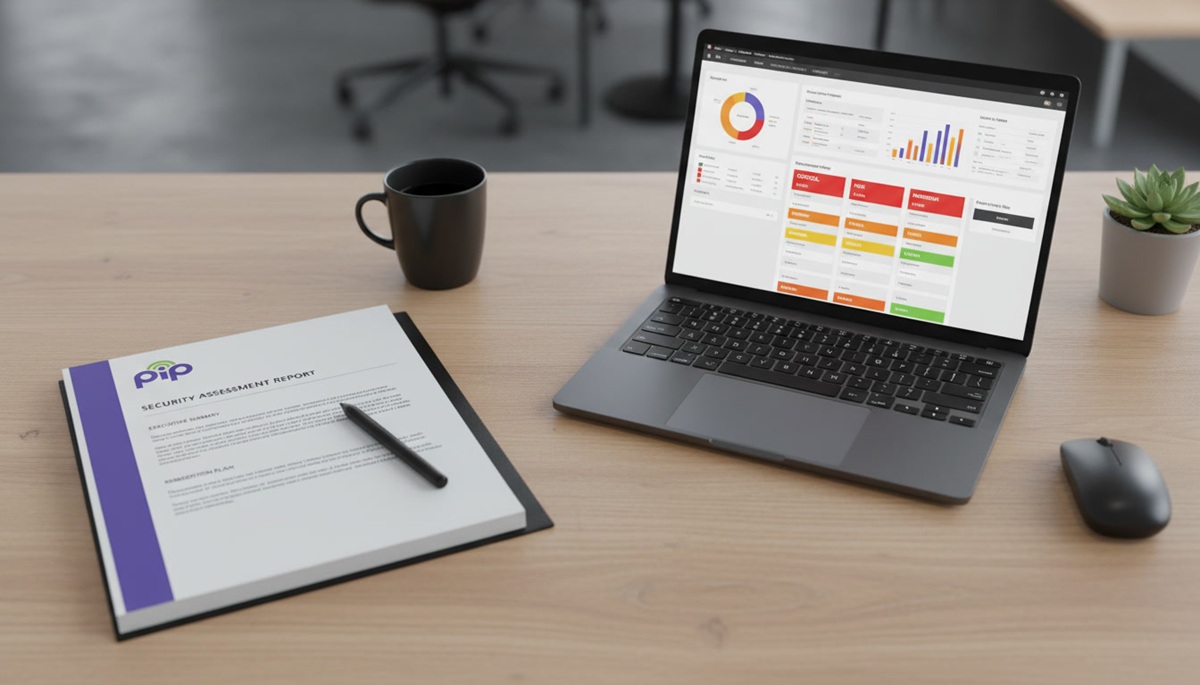
Every penetration testing engagement concludes with a detailed report: executive summary for non-technical stakeholders, detailed technical findings with evidence and severity ratings, and a prioritised action list. PIP also offers retesting to confirm remediation efforts were effective.

Penetration testing deliverables
Executive Summary
Non-technical overview of scope, penetration testing methodology, key findings and overall security posture assessment — designed for board, senior leadership, cyber insurance or compliance requirements discussions.
Full Technical Report
Detailed technical findings for each identified vulnerability: description, evidence (screenshots, proof-of-concept), severity rating (critical / high / medium / low / informational) and specific remediation steps. The detailed report your security team and engineers need to act on.
Risk-Prioritised Action List
All findings ranked by severity — so your security team (or PIP) knows what to fix first. This is where penetration testing translates into practical security improvements.
A prioritised action list strengthens your organisation’s security posture against evolving cyber threats and the current threat landscape.
Remediation Guidance
Specific, actionable recommendations for each finding — the actual configuration change, patch, security measure or policy update required. Not generic advice; practical solutions your security professionals can implement immediately.
Retest Option
After remediation efforts, PIP can conduct a targeted retest to confirm that previously identified vulnerabilities have been effectively resolved and no new identified vulnerabilities or regressions were introduced. Regular penetration testing with retesting ensures ongoing assessments maintain your security defences over time.
Retesting is what separates a one-off report from an ongoing testing program that actually reduces risk exposure.
PIP’s penetration testing services include retesting as standard — not an expensive add-on.
“Pen testing is the test that proves your security is real. You can have the right policies, the right antivirus, the right backup — but until someone starts hammering away at your defences, you don’t know if it holds. The clients who commission pen testing for the first time are almost always surprised, not because their IT is badly managed, but because there is always that one service or portal, that had been forgotten. Those small security gaps that nobody was looking for. That’s what the test is for.”
Brad Dixon – PIPWhen to commission penetration testing
Before a major infrastructure change
New network segment, cloud migration, new public-facing web application — penetration testing before go-live catches security vulnerabilities while they are still cheap to fix. Testing after deployment is damage control; testing before is risk management.
As part of your annual security review
Most compliance frameworks (ISO 27001, Essential Eight at higher maturity levels) and many cyber insurance policies require regular penetration testing. Annual pen testing maintains compliance and keeps your cyber security strategy current against evolving cyber threats.
After a security incident
Following a data breach or near-miss, penetration testing confirms that the attack vector has been closed, no related security flaws remain, and your security measures hold. Post-incident pen testing is how you prove the gap is closed — not just patched.
PIP’s penetration testers work with your security team to validate that all security risks from the incident have been fully addressed.
Before a government or enterprise contract
Many government contracts and enterprise procurement processes now specify a penetration testing report as part of security due diligence. PIP’s penetration testing services produce the final report and documentation these compliance requirements demand, from a testing provider with deep technical expertise and 30+ years of Australian IT experience.
Find out where your security defences actually stand
PIP’s security testing simulates real world attacks against your environment — testing how your security defences hold against real world attacks — ethical hacking conducted by experienced ethical hackers who understand Australian business systems — so you know where the security gaps are before an attacker finds them. Strengthen your security defences with an independent, structured test from PIP.
Talk to PIP About Pen Testing →Why penetration testing matters for Australian businesses
Identify vulnerabilities before attackers do
Penetration testing proactively identifies security vulnerabilities, security weaknesses and security gaps in your environment — the kind of exposure that leads to data breaches, ransomware and loss of sensitive data. The cost of a penetration test is a fraction of the cost of a security incident.
For Australian businesses, proactive testing is no longer optional — it is a fundamental part of managing cyber risk and protecting your digital assets, sensitive data and business systems against the threat landscape.
Maintain compliance with Australian requirements
Regular penetration testing helps Australian businesses maintain compliance with ISO 27001, Essential Eight (at higher maturity levels), cyber insurance policies and government procurement requirements. PIP’s testing services produce documentation that satisfies compliance requirements and demonstrates your cybersecurity posture to auditors and insurers.
Strengthen your security posture
Every engagement produces actionable insights and specific remediation guidance — the practical changes that strengthen your security and reduce your risk exposure to evolving cyber threats and the threat landscape. Penetration testing is how organisations move from hoping their security works to knowing they do.
Validate remediation efforts
Retesting after remediation confirms that identified vulnerabilities have been resolved and that your security measures are operating effectively. Without retesting, you are relying on assumption rather than evidence. PIP’s testers provide retesting as part of every engagement.
Penetration testing — common questions
Penetration testing costs in Australia vary based on scope, duration and the type of test. A basic external network pen test for a small business environment typically starts in the range of a few thousand dollars; a comprehensive web application penetration test or a combined internal and external assessment for a larger environment will be priced higher.
PIP scopes each engagement individually — penetration testing cost depends on the number of IP addresses, web applications, cloud environments and the complexity of your network infrastructure. Contact PIP for a quotation based on your specific environment and requirements.
Most pen testing engagements run over 1–2 weeks, depending on scope. A focused external network test may take 3–5 business days from testing commencement to report delivery.
A comprehensive internal and external assessment plus web application penetration testing for a larger environment may take 2–3 weeks. The scoping session at the start of each engagement establishes a clear timeline for PIP’s testing team to follow.
A vulnerability scan is automated — it identifies known security vulnerabilities in software versions and configurations, quickly and at scale using automated tools. Penetration testing goes further: human penetration testers use manual testing, creative attack chains and escalation techniques to find the complex, chained vulnerabilities that automated scans miss.
Both are valuable tools in a security testing program. For most businesses, a cyber security audit and vulnerability assessment comes first, followed by penetration testing to prove whether those vulnerabilities can actually be exploited in a real world attack. PIP provides both pen testing and vulnerability assessment as part of its penetration testing services across Sydney and Australia.
Most compliance frameworks and cyber insurance policies require penetration testing at least annually. Businesses in higher-risk environments — those holding large volumes of sensitive data, operating public-facing web applications, or subject to regulatory requirements — should consider more frequent penetration testing.
PIP also recommends pen testing before major infrastructure changes and after significant security incidents. Regular penetration testing, combined with ongoing vulnerability assessment, ensures your security posture keeps pace with the evolving cyber threats and new threats that affect Australian businesses.
Test your defences before someone else does.
PIP provides authorised penetration testing for Australian businesses — scoped to your environment, executed by experienced penetration testers, and documented in a report your security team can read and your engineers can action. Gain access to PIP’s pen testing services and strengthen your security against real world cyber threats.