
Ransomware Protection for Medical Practices — Healthcare Cyber Defence
- The threat stops here. Clinical records stay accessible.
- Layered ransomware defence for medical practices.
- Backup, detection, recovery controls. In that order.
Ransomware targeting medical practices encrypts clinical records, locks appointment systems through file encryption, and stops Medicare claiming. PIP delivers layered ransomware protection — endpoint security, access controls, backup and rapid recovery — protection solutions built specifically for healthcare environments where ransomware threats put patients and data at risk.
What Ransomware Is — and What It Means for a Medical Practice
Ransomware is malicious code that encrypts a victim’s files — encrypting data — encryption across clinical records, appointment files, and business systems until a decryption key is provided, usually in exchange for payment. When a ransomware attack succeeds, staff see a ransom note on every screen after encryption, demanding ransomware payments in cryptocurrency. Paying does not guarantee the decryption key will be provided, and payment does not guarantee that data has not already been exfiltrated. For protection, prevention is the only reliable approach.
Ransomware attacks occur via several vectors: phishing emails carrying infected attachments, compromised access systems, unpatched software with known vulnerabilities, and social engineering of staff who are not trained to recognise ransomware threats. Many ransomware attacks begin with a single phishing attack — one click — malware delivered via a malicious link — and the malware then spreads through lateral movement across the network, encrypting files on all machines, servers and shared files before the ransom note appears. Privilege escalation allows the ransomware to gain access to higher-level systems — extending the encryption from the initial entry point, which is why access controls and strong passwords matter for defence against ransomware.
Ransomware variants — the dangerous types of malware that target organisations and individuals alike — evolve constantly. Older antivirus software and other security software may not detect these dangerous types — ransomware variants that evade older defences. Modern modern protection solutions use machine learning and advanced threat intelligence for detection, identifying threats and suspicious behavior before malware can encrypt all the data on the network. For medical practices, effective ransomware protection must account for the clinical software environment, the sensitivity of patient data, the threats to clinical operations, and the fact that ransomware attacks on healthcare are not theoretical — they are routine.
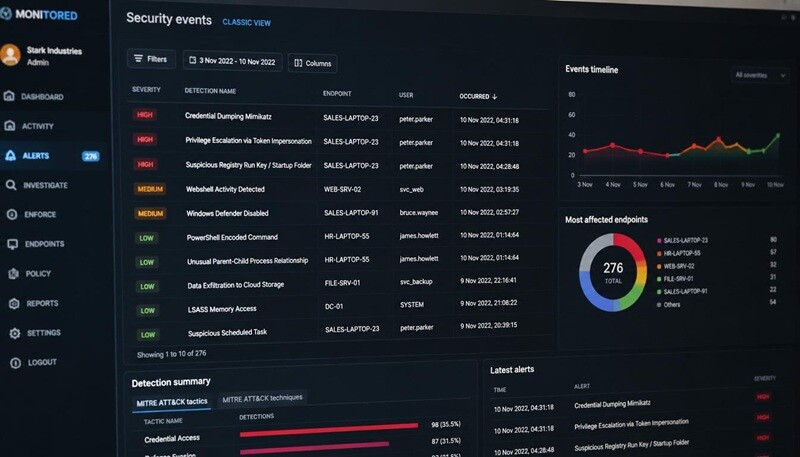
Ransomware detection — endpoint protection at work.
How Ransomware Targets Medical Practices
Healthcare is one of the critical sectors consistently flagged by the Australian Cyber Security Centre (ACSC) as a ransomware target. Medical practices are soft targets for ransomware attacks: limited IT oversight, staff not trained in ransomware threats, legacy clinical software that may not be regularly updated, and on-premises systems that small business operators struggle to protect. The threat to healthcare is not abstract — attacks on GP clinics and specialist practices happen in Australia.
Patient data commands premium prices on criminal markets. Medical records contain sensitive data — personal, clinical and financial information that attackers can exploit for identity fraud. Critical data in clinical records is irreplaceable; reconstructing patient histories from paper files is not a viable recovery strategy after a ransomware attack. Ransomware infections in healthcare also trigger mandatory reporting under the Notifiable Data Breaches (NDB) scheme when patient data is exposed, adding regulatory threats and consequences to the operational and financial losses of a ransomware incident. Human error — weak passwords, clicking malicious links, falling for social engineering — remains one of the most common entry points for this type of malware. Protecting a medical practice from ransomware requires layered defence that addresses every attack vector, not just antivirus software on a few workstations.
The pattern of ransomware attacks on healthcare is clear: ransomware attacks on medical practices are increasing in both frequency and sophistication, and the data at stake — patient files, clinical data, billing data and Medicare records — makes healthcare a premium target. Ransomware threats in this sector are not opportunistic; they are deliberate. A practice that suffers a ransomware attack without tested backups faces the prospect of losing years of patient data — encrypting files that represent entire clinical histories. The financial losses from downtime, combined with the regulatory threats from data breach notification, make this one of the most dangerous types of cyber threat that a medical practice can face. Ransomware attacks in healthcare carry consequences that extend well beyond the initial encryption event.
Essential Ransomware Protection Strategies — What PIP Implements
PIP delivers ransomware protection solutions for medical practices through layered controls. No single tool can stop ransomware — ransomware prevention requires defence in depth. These are the essential ransomware protection strategies PIP implements to prevent ransomware infections, detect ransomware threats early, and recover quickly when ransomware attacks occur.
Endpoint protection
Endpoint security and endpoint detection on all workstations, servers and mobile devices. Machine learning-driven endpoint protection identifies ransomware threats using threat intelligence before ransomware can encrypt files.
Patch management
Microsoft Windows, operating system updates, and all applications kept regularly updated. Known vulnerabilities in Microsoft Windows and other malware targets are eliminated before attackers exploit them. Windows security baselines enforced.
Multi-factor authentication
Multi-factor authentication (MFA) on all remote access points and critical system accounts. Multi-factor authentication is one of the most effective prevention controls — it stops attackers who have stolen credentials from gaining access to systems.
Regular backups
Immutable, offsite backups that an attack cannot reach or encrypt. Regular backups are the best protection against data loss from an attack — PIP maintains daily encrypted backups to store important files on PIP’s own infrastructure in an ISO/IEC 27001 certified Sydney datacentre, air-gapped from the clinical network. Important files are recoverable even after the worst ransomware attacks.
Email defence
Email protection and filtering against phishing emails that deliver ransomware to medical practices. Phishing attacks are the most common ransomware vector in healthcare — inbound mail filtering stops threats before they reach staff inboxes, and staff training reinforces the defence at every workstation.
Access controls
Restrict user permissions to limit privilege escalation and lateral movement if ransomware gains initial access. These controls prevent ransomware from spreading across the practice network after a single workstation is compromised.
Network security measures
Network segmentation and security measures contain ransomware if a system is compromised. Defence at the network layer limits the blast radius of any ransomware attack and protects data on other systems.
Incident response plan
A documented incident response plan so the practice knows exactly what to do when ransomware is detected. Incident response covers containment, communication, recovery and business continuity — the difference between hours and weeks of ransomware downtime.
Security awareness training
Educate employees to recognise ransomware threats, phishing attacks, and suspicious behavior. Ransomware prevention best practices include training staff to stop ransomware before it enters the network through human error.
ASD Essential Eight
PIP implements the ASD Essential Eight framework as a structured approach to ransomware protection for medical practices. The Essential Eight best practices address the most common attack vectors and reduce cybersecurity risks across the system.

Ransomware protection — managed by PIP for healthcare.
Ransomware Protection — Questions Answered
What is the best protection against ransomware?
The best ransomware protection is layered: regular backups (the most reliable recovery from ransomware data loss), multi-factor authentication, endpoint protection with ransomware detection, patched operating system and software, network security measures, and trained staff. No single ransomware protection tool is sufficient — ransomware protection requires defence in depth across the entire practice to stop threats at every vector.
What is ransomware protection?
Ransomware protection is a set of security controls designed to prevent ransomware attacks, detect ransomware infections early, and recover quickly if a ransomware attack succeeds. For medical practices, ransomware protection solutions must account for clinical software environments, the mandatory breach notification obligations under the NDB scheme, and the critical data that ransomware threatens — patient records, appointment files, and Medicare claiming systems.
How do I prevent ransomware?
To prevent infections: keep all software and the operating system regularly updated to close vulnerabilities, use multi-factor authentication on all remote access, educate employees to avoid phishing attacks and malicious links, maintain immutable offsite backups that an attacker cannot encrypt, and restrict access to what each role needs. For medical practices, ASD Essential Eight alignment provides a structured ransomware prevention framework built on best practices that protect against the most common ransomware attack vectors.
Is it good to turn on ransomware protection?
Yes. Windows security’s built-in ransomware protection (Controlled Folder Access in Microsoft Windows) is a useful baseline to protect files from encryption malware — but it is not sufficient on its own for a medical practice. PIP deploys enterprise-grade endpoint security, protection solutions, and detection tools appropriate for clinical systems. Protection should be turned on at every layer: endpoint, network, backup, access, and the security posture of the practice as a whole.
When a practice calls us after a ransomware infection, the first question isn’t ‘what got encrypted?’ — it’s ‘when was the last clean backup and is it intact?’ That question determines whether ransomware recovery is hours or weeks. We’ve cleaned up after ransomware incidents where the backup was compromised too. Those are the ones that remind you why you build ransomware protection before you need it.
— PIP Medical ITRansomware Protection Built for Medical Practices. Before You Need It.
Layered ransomware defence for Sydney GP clinics and healthcare providers — ransomware protection solutions aligned to the ASD Essential Eight. Stop ransomware before it stops your practice.
Protection • threat detection • recovery