
Managed IT Services —
One Provider, Every Layer.
PIP’s managed IT service covers everything — 24/7 helpdesk, proactive monitoring, patching, backup verification, and on-site support. One per-user monthly cost. No surprises.
- 24/7 helpdesk. No asterisks.
- Proactive monitoring, not reactive support.
- PIP-owned infrastructure behind every commitment.
- 24/7 help desk Online
- Proactive monitoring All systems green
- Patch management Up to date
- Managed backup Verified
- Network security Protected
- Cloud services Operational
Most businesses arrive at managed IT services because something is broken — not a system, but a situation. IT is reactive. Problems surface when staff cannot work. The provider takes days to respond and does not know the environment. The business owner or office manager is fielding technical questions they should never have to answer. Day to day IT has become someone’s second job, and it shows.
PIP’s IT managed services were built to replace all of that. Not just the helpdesk, but the monitoring, the patching, the managed backup, the security, the strategy, and the infrastructure underneath it. All of it. One agreement. One per-user monthly cost. One team that already knows your systems before anything goes wrong.
PIP has been delivering IT services to Australian businesses since 1986 — and unlike most managed service providers, PIP owns its own infrastructure. That changes everything about what managed services actually means in practice.
What Are Managed IT Services?
Managed IT services involve outsourcing day to day IT operations to a third-party managed service provider who takes ongoing responsibility for those systems. Rather than calling for support when something breaks, businesses under an IT managed services agreement have a provider continuously monitoring, maintaining, and managing their IT environment — proactively, not reactively.
IT managed services typically include network monitoring, cybersecurity, help desk support, patch management, managed backup and disaster recovery, and cloud services — all delivered under a predictable fixed monthly cost rather than unpredictable break-fix billing.
For businesses without a dedicated internal IT team, managed IT services effectively function as an outsourced IT department. For businesses with an internal IT team, managed service providers can supplement specific areas where specialist expertise is needed.
How Managed IT Services Work
A managed IT services provider takes over responsibility for a defined scope of IT systems under a service agreement. That agreement sets out what is covered, the response standards, and the monthly cost. The managed services provider monitors and maintains those systems continuously — not only responding to incidents but identifying and resolving issues before they become outages.
The client’s staff interact with the provider’s help desk for day to day IT support — password resets, software issues, hardware problems, user onboarding. Behind the scenes, the IT managed services team is monitoring infrastructure, applying patches, verifying backups, and managing security. The business experiences IT that works rather than IT that is constantly being recovered.
Managed IT Services vs Traditional IT Support
Traditional break-fix IT support is reactive: something breaks, you call, you are billed. There is no ongoing monitoring and no accountability between incidents — the provider profits when things break. Managed IT services invert that. Under managed services the provider is responsible for uptime, security and performance, so proactive monitoring, patch management and prevention are in their interest, not just yours.
- Reactive — waits for something to fail
- Billed per incident, unpredictably
- No ongoing monitoring or patching
- Provider profits when things break
- You chase your own updates and backups
- Proactive — prevents issues before downtime
- One predictable fixed monthly cost
- Continuous monitoring & patch management
- Provider accountable for uptime & security
- Backup, security & updates managed for you
Unplanned downtime is estimated to cost Australian businesses around $86 billion a year. Managed IT services exist to prevent the vast majority of those events from happening.
What PIP’s Managed IT Services Include
PIP’s IT managed services operate under a per-user monthly agreement covering the full scope of IT management. These are not limited support packages with core services sold as add-ons — the IT managed services agreement covers everything a business needs its IT environment managed and maintained.
24/7 Help Desk Support
Round-the-clock help desk support — not business hours with an emergency overflow number. The same team answers every time, with full documentation of your IT environment already in front of them. More on PIP’s 24/7 help desk.
Proactive Monitoring and Alerting
An enterprise-grade monitoring platform runs continuously across every device — catching failing drives, threats and capacity limits before they cause downtime. Proactive monitoring is what separates managed IT services from reactive support: most issues PIP resolves are ones you never knew existed.
Patch Management
Operating systems, applications and security tools kept current through scheduled patch management — closing known vulnerabilities and shrinking your attack surface automatically. No staff involvement, and no missed update cycles that leave systems exposed to cyber threats.
Network Security
Continuous network security monitoring is built into every managed services agreement — never a separately priced tier. Firewall rules maintained, access controls kept current and cyber threats watched around the clock, without the internal resources most businesses cannot sustain.
Managed Backup and Disaster Recovery
Backups are not assumed — every job is actively verified. Managed backup is paired with tested disaster recovery, so a failed system means a known recovery path, not a backup nobody ever restored. Business continuity depends on both.
Cloud Services and Cloud Migration
Microsoft 365, hosted apps and PIP’s own private cloud — your cloud services managed end to end. Cloud migration is handled by PIP’s team, with data kept onshore in an Australian datacentre PIP owns, not a hyperscaler whose residency is unclear.
Network Management
Servers, switches, routers and internet connections monitored and maintained as standard scope — not a separate service. Network management and infrastructure are handled proactively, across the physical and virtual layers your business runs on.
IT Consulting and Strategic Guidance
A dedicated account manager and senior engineer guide your technology decisions — what to adopt, what to retire, how your IT should grow. Not generic IT consulting: informed advice from engineers who already know your environment and its history.
How PIP Onboards a New Managed Client
PIP’s onboarding process is one of the most important practical differences between PIP and most managed service providers. Most service providers start billing before they understand the environment. PIP does the opposite.
Before IT managed services begin, PIP conducts a structured four-stage onboarding process. The business pays for managed services. Not for the audit — but the audit happens first, because managing an undocumented environment is not managing it at all.
Full System Audit
Every device, application, user account, and system configuration is documented. The audit establishes a complete inventory of the IT environment — what exists, what version it is, and what state it is in. This becomes the baseline for all ongoing managed IT services and gives PIP’s help desk team the context they need to support staff from day one.
Backup Verification
Every backup job is located, tested, and verified before PIP takes ongoing responsibility for it. This step frequently reveals problems the business was unaware of — backup jobs that had been silently failing, backup targets that had filled without alerting, or restore processes that had never been tested. Managed backup begins from a verified state, not an assumed one.
Security Assessment
Security risks across the environment are identified and prioritised before managed services go live. Open ports, outdated systems, weak access controls, missing multi-factor authentication, and other vulnerabilities are surfaced and addressed. The managed IT services agreement begins with known risks addressed rather than inherited.
Environment Documentation
All findings from the audit, backup review, and security assessment are compiled into a centralised documentation system accessible to PIP’s entire support team. When a staff member calls the help desk on day one, the engineer answering already knows the IT environment — the hardware, the applications, the network layout, the quirks. That is what managed IT services should look like from the start.
We have taken on clients where the previous managed IT services provider could not tell them what was being backed up, or whether monitoring was even running. Before PIP agrees to manage an environment, we document everything. The audit sometimes uncovers things the business did not know existed — shadow accounts, expired certificates, backup jobs that had been silently failing for months. That work happens before we start billing. It is not the industry norm. It should be.
The Key Benefits of Managed IT Services
The business case for IT managed services comes down to a few core advantages — predictable costs, reduced downtime, and access to specialist expertise that most businesses cannot afford to employ permanently. Here is what those benefits look like in practice.
Predictable, Fixed Monthly Costs
Unpredictable break-fix billing becomes one fixed monthly cost per user. IT turns into a manageable line item — with none of the overhead of recruiting, training and retaining internal IT staff, or the key-person risk when they leave.
Proactive Support Prevents Downtime
Continuous monitoring catches failing hardware, security threats and performance issues early — resolved in maintenance windows, not during business hours when downtime costs the most. Proactive support keeps business-critical systems running and cuts disruptive incidents.
Access to Specialised Expertise
A whole team across networking, security, cloud services and infrastructure — for less than a single internal hire. The kind of specialised expertise that would take several full-time staff to cover, available under one managed services agreement.
Improved Business Continuity
Prevention plus preparedness: proactive monitoring, verified managed backup and tested disaster recovery. When something does fail, the path back is known and rehearsed — not improvised — which is what keeps business continuity intact.
Data Security
Security as an ongoing discipline, not an annual audit — patch management, network security monitoring and access control maintained continuously, with proactive response to emerging cyber threats. Sustained attention you do not have to staff yourself.
Focus on Your Core Business
IT stops being the owner’s second job. Internal teams get back to the work that drives revenue, and core business operations run uninterrupted by problems that should never have reached staff in the first place.
Managed IT Services for Small Business
Managed IT services for small business are the primary market PIP was built to serve. The 10–50 staff business with no dedicated IT team, no visibility into its own IT environment, and no strategic guidance about where its technology is heading — that business is who managed IT services exist for.
Enterprise IT Tools at SMB Pricing
PIP delivers enterprise-grade IT managed services at a cost structure accessible to small and medium-sized businesses. The monitoring platform, documentation systems, security tooling, and account management disciplines PIP uses are the same tools and processes used in large enterprise environments. What changes is the pricing model — per-user monthly fees that scale with the business rather than fixed costs built around enterprise contract volumes.
Small businesses using managed services gain access to IT infrastructure management, security monitoring, and strategic IT guidance that would cost significantly more to replicate internally — without the overhead of employing the staff to deliver it.
Replacing Your IT Department
For businesses with no internal IT team, PIP’s managed IT services function as a complete outsourced IT department. A dedicated account manager and senior engineer are assigned to the environment. The help desk knows the business’s systems. IT decisions — what to upgrade, what to retire, when to invest — are informed by engineers who understand the specific environment and business objectives rather than made in isolation by a generalist.
The managed IT services agreement covers everything an IT department would handle: day to day desk support, patch management, security, backup, cloud services, network management, and strategic guidance. One provider. One monthly cost. One IT department, without the cost of building one.
Outsourced IT Services
Outsourced IT services through an IT managed services provider means the provider takes full accountability for IT outcomes — not just for responding to tickets, but for the security, uptime, and performance of the environment. Done well, outsourced IT services give a business better IT than it could build internally at equivalent or lower cost, with the added benefit that the managed IT services provider’s team has seen more environments, more incidents, and more technology changes than any single internal hire could accumulate.

Who PIP’s Managed IT Services Are Built For
Sydney SMBs Without a Dedicated IT Team
The most common reason Sydney businesses engage PIP for managed IT services is straightforward: there is no IT person. Someone in the office handles IT on top of their actual job — usually the most technically comfortable person in the room, who is now fielding printer issues, ransomware alerts, and Microsoft 365 licensing questions that have no business sitting with them.
PIP’s IT managed services are specifically structured for 10–50 staff businesses that need a full IT department without the cost of building one. Predictable per-user monthly pricing. Dedicated account manager. Senior engineer assigned to the environment. 24/7 help desk. Proactive monitoring. Everything included. Day to day IT handled — not escalated back to the business owner.
Larger Organisations With Skill Gaps
PIP also partners with larger organisations that have a capable internal IT team but specific areas where that team’s skills do not extend. A current example: PIP manages and monitors the complete VMware virtualisation infrastructure for a 380-user construction company. Their internal IT team handles all of the virtual machines and day to day user support competently — they simply do not have the skills to manage the underlying virtualisation platform. PIP provides that specialist layer without replacing the internal team.
This model suits any organisation where the internal IT team has reached the edge of its expertise in a specific area — whether that is virtualisation, network security, cloud managed services, compliance, or IT infrastructure management. PIP supplements, not supplants. The managed IT services agreement covers only the scope where PIP’s specialist expertise adds value.
One Provider for IT, Internet, Voice and Cloud
What separates PIP from most managed service providers is not a service catalogue difference — it is what sits behind the service. PIP owns its own datacentre in Pymble, NSW. PIP built and operates its own national internet network, established in 1995. PIP owns its telephony infrastructure. This infrastructure ownership changes what managed IT services actually means when PIP delivers it.
No Third-Party Service Providers in the Chain
Most managed service providers are resellers. When internet connectivity fails, they escalate to a carrier. When cloud services have an outage, they raise a ticket with the platform provider. When the business calls, the managed IT services provider explains that the issue is with a third party service provider and they are waiting on an update. The client waits.
PIP does not have that problem. When something goes wrong across internet, cloud, or IT — PIP owns all three. There is no carrier to escalate to. No application service provider to wait on. No conversation between vendors about whose fault it is. PIP resolves it.
One Agreement, One Support Team
A business using PIP for managed IT services can also use PIP for internet connectivity, cloud hosting, and business telephony — all under a single provider agreement, a single invoice, and a single support team. This is not a bundling offer. It reflects that PIP genuinely owns and operates all of these infrastructure layers. The single provider model eliminates the vendor finger-pointing that is endemic in environments where managed IT services, internet services, and cloud services are sourced from different providers.

What Are Examples of Managed IT Services?
Managed IT services cover a broad range of IT functions delivered on an ongoing basis by an IT managed services provider. Common examples include:
- Help desk support — day to day technical support for staff via phone, remote access, and on-site assistance
- Proactive monitoring — continuous surveillance of IT systems to detect and resolve issues before they cause outages
- Patch management — automated deployment of operating system and application updates
- Managed backup and disaster recovery — regular backup execution, verification, and tested recovery processes
- Network security and management — firewall management, network security monitoring, and infrastructure management
- Cloud services management — management of cloud environments including Microsoft 365, hosted applications, and private cloud infrastructure
- IT consulting — strategic technology planning and guidance aligned to business goals
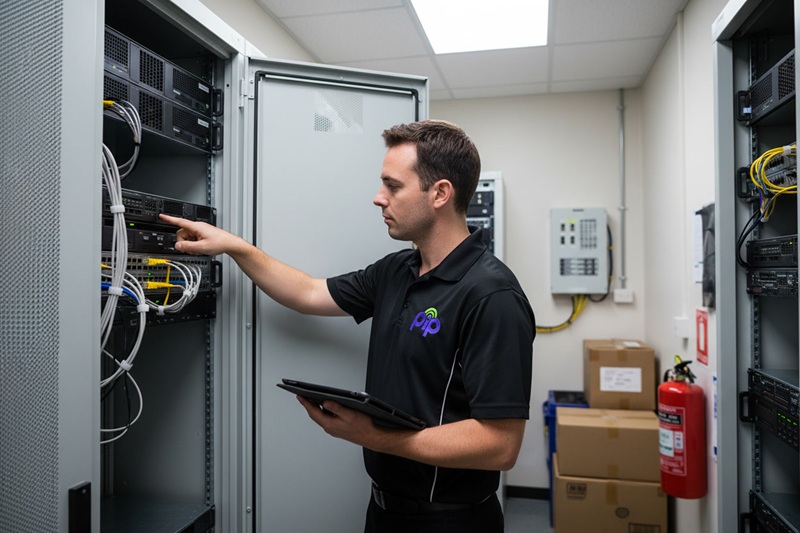
- On-site IT support — physical support for hardware, cabling, office fit-outs, and hands-on troubleshooting
Managed IT services are also available for specific verticals — managed IT services for law firms, managed IT services for healthcare, and managed IT services for professional services organisations all exist as specialised variants of the core managed services model, tailored to the compliance and workflow requirements of those industries.
What Are the Big 5 IT Services?
The five core managed IT services that most businesses require are:
- Help desk and user support — the frontline of managed IT services, handling day to day technical issues for staff
- Network and infrastructure management — monitoring and maintaining the servers, network hardware, and connectivity that business systems run on
- Cybersecurity services — including network security monitoring, patch management, access control, and threat response
- Managed backup and disaster recovery — protecting critical business data and ensuring a tested recovery path when systems fail
- Cloud services management — managing cloud infrastructure, cloud migration, and cloud managed services including platforms like Microsoft 365
Some managed service providers also include managed print services as a sixth category — managing printer fleets, consumables, and support under the same agreement. PIP’s managed IT services focus on the five core areas above, with print management available on request for environments where it is relevant.
Who Is the Largest MSP?
Globally, the largest managed service providers include organisations such as IBM, Accenture, and Hewlett Packard Enterprise — companies operating at national government and multinational enterprise scale. These are not the managed service providers relevant to most Australian businesses.
For Sydney businesses — the 10–200 staff organisation that needs reliable managed IT services, local on-site support, and a provider who answers the phone and knows their systems — scale at that level is irrelevant and often counterproductive. Large managed service providers cannot provide the local support, the direct engineer relationships, or the accountability that a Sydney-based managed IT services provider like PIP delivers. The right managed IT services provider is the one whose team shows up on-site when needed, not the one with the most global revenue.
Choosing the Right Managed IT Services Provider
Choosing an IT managed services provider is a long-term decision. Most businesses stay with a managed IT services provider for years — the onboarding investment, the environment documentation, and the relationship between the provider’s team and the client’s staff make switching costly. Getting the initial choice right matters.
Look for an MSP That Owns Its Infrastructure
Most managed service providers are resellers of other companies’ infrastructure. When they say they provide cloud services, they are reselling someone else’s cloud. When they provide internet connectivity, they are reselling a carrier. That means when something fails, they are dependent on a third party service provider to fix it — not their own team.
An IT managed services provider that owns its own infrastructure — datacentre, internet network, cloud platform — has a fundamentally different accountability model. They can fix the entire stack, not just the parts they control. That is the distinction PIP makes from most managed services providers in Sydney.
Local Support Matters
Managed IT services that cannot put a technician on-site are incomplete for most businesses. Remote support resolves a significant proportion of issues, but hardware failures, office relocations, cabling, and hands-on troubleshooting require physical presence. An IT managed services provider operating locally — with engineers who can be on-site across Greater Sydney within a reasonable timeframe — provides reliable support that a remote-only model cannot.
PIP’s on-site IT support coverage spans all of Greater Sydney — from Penrith and Liverpool in the west across the CBD and North Shore to the Northern Beaches — and includes the Central Coast. Read more about PIP’s on-site IT support.
Service Level Agreements
A managed IT services agreement should include a service level agreement that defines response times, resolution expectations, and the scope of what is covered. The SLA establishes accountability — if the managed IT services provider does not meet its response commitments, that should be visible and measurable, not buried in vague language about best-effort support. Ask any managed service provider for their SLA before signing. A good managed IT services provider will have one ready.
Managed IT Services Coverage — Greater Sydney
PIP delivers IT managed services across Greater Sydney and the Central Coast from its North Shore headquarters in Pymble. On-site IT support is available across the full Sydney metro area — CBD, North Shore, Hills District, Northern Beaches, Inner West, Eastern Suburbs, Parramatta, Penrith, Liverpool, and South Sydney.
On-Site Support Across Sydney
PIP’s engineers travel to client sites across Greater Sydney for hardware installation, cabling, infrastructure commissioning, office moves, and hands-on troubleshooting. The Central Coast is treated as part of PIP’s primary service area — not an exception requiring a separate arrangement. For project-based work, PIP also travels nationally: PIP’s team currently flies and drives interstate to commission a multi-site rollout for a 200-staff organisation across multiple Australian states.
Talk to PIP About Managed IT Services
If your business is managing IT reactively, working with a managed IT services provider who does not know your systems, or ready to move from break-fix to a properly managed IT services model — PIP is the right conversation to start. PIP has been delivering IT managed services to Sydney businesses since 1986, owns its infrastructure, covers the full Sydney metro area on-site, and operates as a single provider for IT, internet, voice, and cloud. Managed IT services done properly.