Cloud PBX Australia — Hosted in PIP’s Own Datacentre
Most hosted PBX providers run on AWS, Azure, or a carrier’s shared platform. PIP hosts on infrastructure it has owned and operated since 1995. No public cloud in the chain. No US-based server handling your calls.
One accountable provider. From the handset to the host.
A cloud PBX replaces your on-premises phone system hardware with a PBX hosted in a datacentre. Your handsets connect over the internet. Extensions, hunt groups, IVR, and voicemail all work exactly as they would on a physical system.
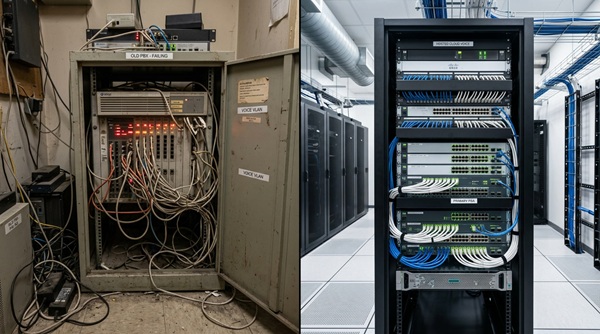
Except there’s no hardware on your premises to fail. No maintenance contracts on ageing equipment. No single point of failure sitting in your server room.
Most cloud PBX providers host your system on AWS, Azure, or a carrier’s shared platform. PIP hosts on infrastructure it has owned and operated since 1995. There is no public cloud in the chain, no US-based server handling your call data, and no wholesale carrier between PIP and your handsets.
When something needs attention — a configuration change, a new extension, a fault — it’s PIP’s team on PIP’s hardware. The same team that manages your internet connection and your broader IT is accountable for every call your business makes.
The copper PSTN network is being retired. Migration to VoIP is when, not if.
The economics shift permanently once your on-premises PBX needs its first major repair or replacement. Cloud hosting removes the hardware lifecycle from your IT budget entirely.
✓ Cloud PBX (PIP Hosted)
On-Premises PBX
Hardware on-site
✓ None
PBX unit, cards, cabling
Hardware failure risk
✓ PIP’s datacentre — redundant
✗ Your server room
Maintenance
✓ Included — managed by PIP
✗ Vendor contracts, ageing parts
Scalability
✓ Add extensions instantly
✗ Hardware capacity limits
Multi-site
✓ One PBX across all locations
Separate systems or ISDN tie lines
Upfront cost
✓ Low — no hardware purchase
✗ Hardware + installation
Updates
✓ Applied by PIP, no downtime
Manual, often deferred
Data location
✓ PIP’s Australian datacentre
Your premises
Why PIP’s Hosted PBX Is Different
PIP owns the infrastructure. Not a reseller. Not a cloud tenant.
PIP owns the infrastructure underneath it
The majority of hosted PBX providers in Australia run on Telstra, Optus, or a public cloud platform. PIP built its own datacentre in 1995 and operates its own network. Your PBX runs on PIP’s own hardware in PIP’s own facility — not a shared carrier platform.
Australian data — no offshore cloud
Your call data stays on Australian soil and never transits a US-based cloud. This matters for businesses under the Australian Privacy Act and for any organisation that takes data sovereignty seriously.
Sydney-based support — onsite when needed
PIP’s team configures your hosted PBX, provisions extensions, and is available by phone or on-site across Greater Sydney. Not a remote-only support relationship. If something needs a site visit, PIP’s technicians come to you.
Works with your existing IP handsets
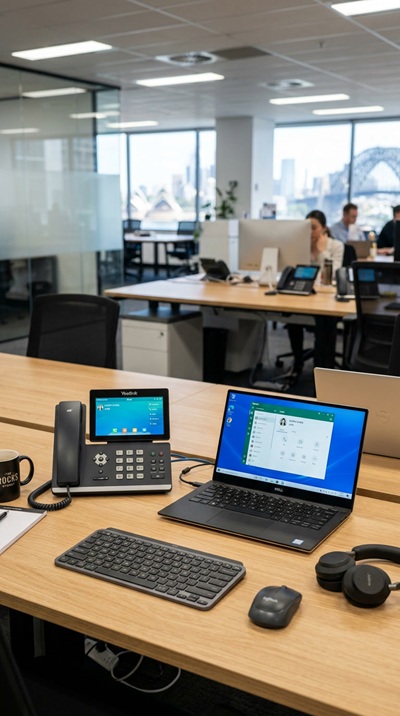
If your business already has Yealink, Cisco, or other SIP-compliant IP phones, PIP’s hosted PBX connects to them without a hardware replacement. New Yealink handsets supplied and configured if needed — PIP is an authorised reseller.
Part of your managed IT
PIP’s hosted PBX can be included in a managed IT contract. Phone system, internet connection, network, and servers all managed by one team — one point of contact, one monthly agreement, one call when something needs attention.
One accountable provider
Quality of service that PIP controls directly. No blame-shifting between a hosted PBX provider, a separate carrier, and an IT support company. PIP is accountable from the handset to the host — and supplies the internet connection if you need it.
The NBN Transition
Everything a business phone system needs. Nothing extra to buy.
Extensions — internal calling between handsets and sites
Direct inward dialling (DID) — individual numbers per extension
Hunt groups — sequential or simultaneous ring
Auto-attendant / IVR — configurable inbound menus
Voicemail per extension with voicemail-to-email
Call forwarding and diversion to mobiles or externals
Conference calling — multi-party, no external bridge
Music on hold — custom audio files supported
Call recording — stored on PIP’s Australian infrastructure
Softphone support — mobile and desktop for remote staff
Multi-site — one PBX across all office locations
Every feature. One provider. One call when something needs attention. Most businesses end up with a phone system from one company, hosted by another, supported by a third — and when something goes wrong, everyone points at someone else. PIP supplies the handsets, hosts the PBX, and manages your internet connection. There is no gap between any of those things, and there is no other number to call.
Your on-premises PBX is one failure away.
Move to a hosted PBX before the hardware decides for you.
Most on-premises PBX units last 10–15 years. When they fail, parts are often unavailable and replacements come at full cost on no notice. PIP can provision a hosted PBX and reconfigure your existing handsets in hours — or plan a proper migration on your terms before you reach that point.
A standard hosted PBX for a small business can be provisioned and tested within 1-2 business days. In emergency situations — such as an on-premises PBX failure — PIP can roll out a PBX system within minutes or hours.
Multi-site in one system
One PBX. Multiple offices. Internal extension dialling between all of them.
A second site added under the same system — same extension plan, internal calls between locations, one number that rings both. Your old hardware could never have done that.
Is It Right For You?
Cloud PBX is the right move if…
You’re replacing an end-of-life or recently failed on-premises PBX
Your business is growing and you’ve outgrown your current phone system without wanting to buy more hardware
You’re a multi-site business that wants a single phone system with internal extension dialling across all locations
You’re moving to NBN and want a modern phone system to go with the new connection
You want to eliminate on-premises PBX hardware from your infrastructure entirely
You have remote or mobile staff who need the same extension on their laptop or phone as at their desk
PIP can provision a hosted PBX and reconfigure your existing SIP-compatible handsets remotely — within the same business day. Number porting follows once you’re back on calls. Don’t wait for a hardware quote from a vendor when the system is already down.
Already have SIP phones?
If your business already has Yealink, Poly, Cisco, or other SIP-compliant IP handsets, PIP’s cloud PBX connects to them without replacement. Your existing hardware investment stays in place — only the system it connects to changes.
From assessment to live calls — fully managed.
1
Assessment
Extensions, call volumes, hunt groups, IVR, and after-hours routing. Documented before provisioning begins.
Existing numbers transferred from your current provider. PIP coordinates timing for continuity.
4
Handset Config
Existing SIP handsets reconfigured remotely. New Yealink handsets supplied, configured, and delivered.
5
Testing & Go-Live
Full inbound and outbound testing across all extensions. Hunt groups and IVR verified. No go-live until everything works.
6
Ongoing Management
Configuration changes, new extensions, additional DIDs, and faults handled by PIP — included in managed IT or per-request.
IN PRACTICE
” We provisioned them on our hosted PBX, reassigned all their extensions, and reconfigured their existing Yealink handsets remotely. They were taking calls by Friday morning. Three weeks later they asked us to add a second site in Parramatta under the same system — same extension plan, internal calls between sites, one number that rings both locations.“
Not sure whether cloud PBX is right for your current setup? PIP will assess your existing phone system and give you a straight answer on the best path forward.
A cloud PBX is a business phone system where the PBX — the software that manages your calls, extensions, and routing — is hosted on a server rather than a physical box on your premises. Your IP phones connect to it over your internet connection. PIP hosts its cloud PBX on its own Australian datacentre infrastructure.
Is a cloud PBX the same as a hosted PBX?
Yes — cloud PBX and hosted PBX refer to the same concept. The distinction that matters is where it’s hosted. PIP hosts on its own infrastructure; most providers use a public cloud platform or shared carrier environment.
Will my existing IP phones work with PIP’s cloud PBX?
In most cases, yes. PIP’s hosted PBX supports any SIP-compliant IP handset. Your existing Yealink, Cisco, Poly or other SIP phones can be reconfigured to connect to PIP’s system without replacement.
Is cloud PBX reliable enough for a business?
PIP’s hosted PBX runs on redundant infrastructure in its Australian datacentres. Uptime is maintained at the infrastructure level by PIP — not dependent on a single piece of hardware at your premises. The reliability of your calls depends primarily on the quality of your internet connection, which PIP can also supply.
Can I keep my existing business phone numbers?
Yes. PIP handles number porting from your current provider. Most standard Australian business numbers port within 5–10 business days.
How do remote or mobile staff connect?
PIP’s hosted PBX supports softphone apps on mobile and desktop — staff working from home or on the road use the same extension as their desk phone. Calls to their extension ring on both.
What happens if my internet goes down?
Typically we run 4G or 5G internet backup systems for phone systems that require a high up time. Alternatively PIP can instantly configure call diversion rules that automatically redirect inbound calls to a mobile or alternate number if your internet circuit drops. The PBX itself remains live — only the on-site handsets are affected.
How quickly can a cloud PBX be set up?
A standard hosted PBX for a small business (5–20 extensions) can be provisioned and tested within 1-2 business days. Number porting takes 5–10 business days. However we have a huge pool of free numbers that can be used in the interim, with your primaries diverted, keeping you running 24×7. In emergency situations — such as an on-premises PBX failure — PIP can provision a temporary system within hours.
Ready to move your phone system to the cloud?
Contact PIP to discuss hosted PBX — Australian infrastructure, Sydney support, one team for phones, internet, and IT.