
|
|
Proxmox Mail Gateway
|
Proxmox Datacentre Manager
|
Enterprise virtualisation, with no lock in.
Proxmox VE

Enterprise virtualisation doesn’t need to be expensive, opaque or locked behind restrictive licensing. Proxmox Virtual Environment is an open source server virtualisation management solution based on QEMU/KVM and LXC. Proxmox Virtual Environment delivers a powerful, open‑source platform that combines virtual machines, containers, clustering, storage, networking and high availability into a single, unified system. Proxmox gives organisations complete control over their infrastructure without compromise. Key features include advanced virtualisation management, clustering, flexible storage options and extensive networking capabilities.
At PIP, Linux and UNIX aren’t trends, they are our foundation. For decades, we’ve engineered, secured and supported mission critical systems built on open platforms. Proxmox VE aligns perfectly with our philosophy: transparent technology, predictable performance and infrastructure that engineers can actually understand, audit and trust.
Together, Proxmox and PIP form a genuine enterprise partnership. Proxmox provides the world class virtualisation platform, whilst PIP delivers the real‑world design, deployment, migration and long term support that creates a production ready solution. The result, a modern virtual infrastructure – engineered appropriately, supported locally and built to a scale and budget with your business in mind.
Enterprise Virtualisation with Proxmox Virtual Environment
Delivered, Supported and Engineered by PIP
Modern infrastructure demands performance, resilience, transparency and control.
Proxmox Virtual Environment (Proxmox VE) is an enterprise grade, open source software, virtualisation platform that has combined KVM virtual machines, Linux containers, software defined storage, software defined networking, clustering,and high availability into one, single, unified system.
At PIP, we’ve been designing, deploying and supporting UNIX and Linux systems for decades. Proxmox VE aligns perfectly with our engineering philosophy: open standards, predictable performance and infrastructure that can be understood, audited and controlled. All without vendor lock in or loss of control.
Together, Proxmox and PIP form a partnership that delivers enterprise virtualisation done properly.
What Is Proxmox Virtual Environment?
Proxmox Virtual Environment is a Type‑1, bare‑metal virtualisation platform built on Debian GNU/Linux. It integrates two virtualization technologies:
- KVM (Kernel based Virtual Machine) for full virtual machines
- LXC (Linux Containers) for lightweight, system‑level containers
Proxmox VE is based on Debian GNU/Linux and uses a modified Ubuntu LTS kernel.
Both technologies are managed through a single web based management interface, CLI and REST API. Allowing organisations to consolidate workloads without running separate platforms for VMs and containers.
Unlike proprietary hypervisors, Proxmox VE is 100% open source (GNU AGPLv3). There are no feature restricted editions. Every deployment includes the full enterprise feature set.
Proxmox VE is released under the terms of the GNU Affero General Public License, version 3.
System Requirements and Architecture
Deploying the Proxmox Virtual Environment (Proxmox VE) begins with an understanding of its system requirements and architectural design, key factors that ensure reliable performance and scalability in any data centre. As an open source platform with enterprise class features, Proxmox VE has been engineered to make the most of your existing resources while providing the flexibility to grow as your needs evolve.
Proxmox VE System Requirements: At a minimum, each Proxmox VE host requires a 64 bit processor with virtualization support (such as Intel VT-x or AMD-V), at least 2 GB of RAM and two network interfaces to enable advanced networking functionality. However, realistically for production environments and to fully leverage the platform’s capabilities, a multi core CPU, generous RAM allocation and high performance storage array is what you are after. Allowing both virtual machines and Linux containers (LXC) to run efficiently, supporting demanding workloads and multiple concurrent users.
Storage and Networking: Proxmox VE supports a wide range of storage types, this includes: local disks, NAS, SAN, and iSCSI. These storage types, allows organisations to tailor their storage architecture to their specific needs or utilise pre existing storage mechanisms. Whether you require high speed local storage for performance critical VMs or shared storage for clustering and high availability, Proxmox VE offers complete flexibility to integrate seamlessly with your existing infrastructure. As for networking, the platform supports both IPv4 and IPv6 and provides typical advanced networking functionality such as bonding, bridging and VLANs. Enabling the creation of complex, isolated private networks. Proxmox also supports software defined networking for dynamic, scalable environments.
Architectural Overview: Built on the rock solid foundation of Debian Linux, Proxmox VE combines the power of the KVM hypervisor for full virtualization with the efficiency of Linux Containers (LXC) for lightweight, system level virtualization. By providing your access to this dual system, Proxmox allows you to easily virtualise both traditional server workloads and modern, containerised applications on a single platform. The intuitive, single web based interface streamlines the management of both full VMs and containers, while also proving a comprehensive command line interface and RESTful API for advanced automation and integration.
Enterprise Virtualization Ready: With its flexible architecture, comprehensive virtualisation support and seamless management of virtual machines and containers, Proxmox VE is purpose built for all enterprise virtualisation. Whether you’re consolidating legacy servers, deploying new application workloads, or building a scalable private cloud, Proxmox VE provides the tools and reliability in a single platform, needed to manage your IT infrastructure with confidence.
Installation process: You can install Proxmox VE server either on your hardware from USB or CD-ROM using the ISO image, or alternatively on top of an existing Debian installation. The ISO image is available for download and is essential for installing or upgrading the platform.
Proxmox VE Core Virtualisation Features
KVM Virtual Machines
Proxmox VE uses KVM, the Linux kernel’s native virtualisation engine. KVM delivers near bare metal performance for Linux and Windows workloads. Each VM runs with fully virtualised hardware, supporting modern CPU extensions (Intel VT‑x / AMD‑V), NUMA awareness, PCIe passthrough and secure boot scenarios.
Why this matters: KVM is not an add on. It is part of the Linux kernel itself. This means faster security updates, long term stability and no reliance on proprietary hypervisor layers.
LXC Containers
Alongside VMs, Proxmox VE host provides first class Linux Containers (LXC). Containers although behaving like lightweight virtual machines, they actually share the host kernel, thus offering extremely high efficiency and rapid deployment.
With recent Proxmox VE releases, OCI image support for LXC allows modern application images to be deployed directly. This eliminated the need for Docker or Kubernetes inside a VM.
Why this matters: Especially with the explosion in AI software, you can run databases, application servers, internal services and microservices side by side with traditional VMs on the same platform—without complexity.
Clustering & High Availability (No Single Point of Failure)
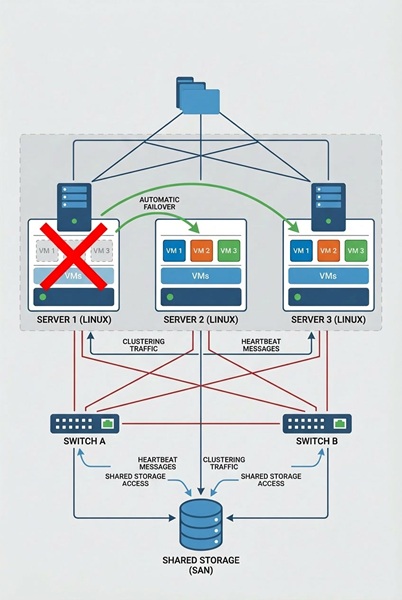
Proxmox VE is designed for cluster first operation, offering extensive cluster management capabilities. Multiple nodes are joined into a cluster, forming ve clusters or proxmox ve clusters, with real time configuration synchronisation, acheived using the Proxmox Cluster File System (pmxcfs). Scalability allows Proxmox VE systems to start with a single node and easily scale into large multi-node clusters as needs grow. Proxmox VE uses the Corosync cluster engine to manage the cluster.
Proxmox VE supports live migration for guest machines between nodes in the scope of a single cluster.
For those organisations managing multiple pve clusters or multiple proxmox environments, Proxmox has developed tools such as the Promox Datacentre Manager, for integrating several clusters within a single infrastructure, enabling centralised control and efficient resource management.
High Availability (HA)
Proxmox’s built in HA manager automatically:
- Detects node failures
- Restarts VMs and containers on surviving nodes
- Enforces placement and affinity rules
Proxmox VE integrates out of the box tools for configuring high availability between servers, software defined storage, networking and disaster recovery. Configuring high availability for your cluster is straightforward. Proxmox VE offers high availability for clusters based on the Corosync communication stack. Under this system, individual virtual servers can be configured for high availability using the integrated HA manager. If a Proxmox node becomes unavailable or fails, the virtual machines can be automatically moved to another node and restarted.
All HA tasks can be configured, controlled and performed all without requiring an external management server thanks to Proxmox’s multi master architecture.
Why this matters:No central controller, no single point of failure and no expensive add on licensing.
Live Migration & Maintenance Without Downtime
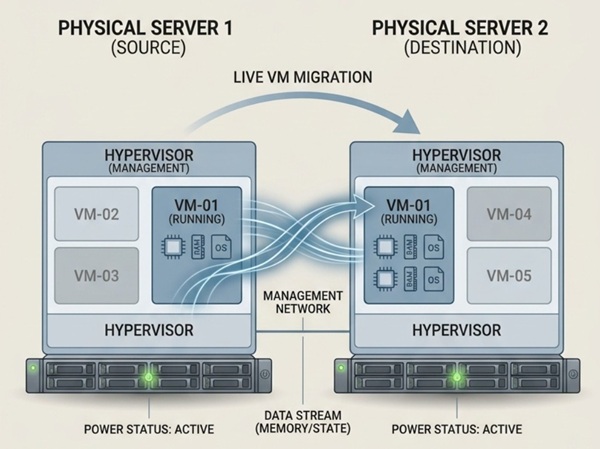
Proxmox VE supports live migration of running VMs and containers between nodes, this allows:
- Hardware maintenance during business hours
- Load balancing across hosts
- Zero downtime upgrades
Storage aware migrations work seamlessly across shared storage, Ceph clusters or replicated local storage.
Why this matters: Live migration allows critical systems to be maintained, upgraded and rebalanced without downtime. Ensuring business operations remain uninterrupted while infrastructure evolves.
Software Defined Storage (SDS)
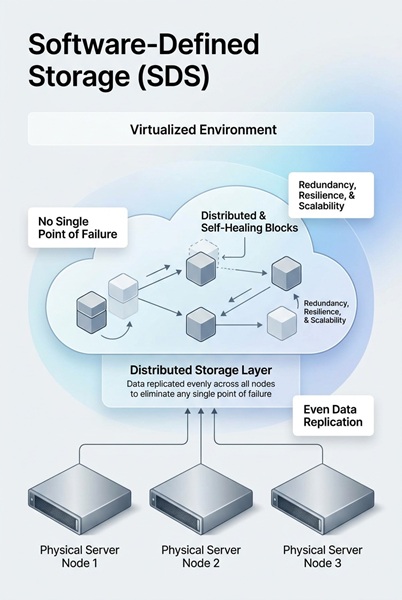
Proxmox VE includes native support for mainstream enterprise storage backends. Offering a wide range of storage options to enhance virtualisation scalability, data management and flexibility. Proxmox VE is at home with the distributed file system Ceph, which can be used as shared storage for guest machines, creating a powerful, Hyper Converged platform at minimal expense.
ZFS
- End‑to‑end checksumming
- Snapshots and replication
- Compression and data integrity guarantees
Ideal for single nodes or replicated clusters.
Ceph (Hyper Converged Storage)
Proxmox integrates Ceph directly into the platform, enabling:
- Distributed, self healing storage
- No SAN or NAS dependencies
- True hyper converged infrastructure (HCI)
Ceph management, monitoring and benchmarking are fully integrated into the dashboard.
Traditional Storage
Support also includes iSCSI, NFS, Fibre Channel, LVM and directory based storage, allowing Proxmox to fit into existing enterprise storage environments.
Software Defined Networking & Firewall
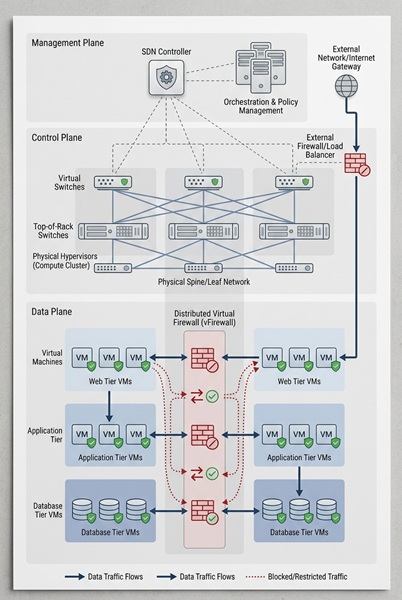
Proxmox VE includes enterprise grade networking straight out of the box:
- Linux bridges and VLANs
- Software Defined Networking (SDN) with VXLAN, EVPN and routed fabrics. Supporting complex overlay networks across different locations and multiple PVE clusters
- Integrated cluster aware firewall at datacentre, node, VM or container level
You can configure an isolated private network on an individual node to ensure secure, private segments for VMs and containers, enhancing isolation and security.
Firewall rules are centrally managed within the web portal and enforced consistently across the cluster. Proxmox VE offers a complete security framework with role based access control (ACL) and a built in distributed firewall. For authentication, options include LDAP and linux pam, allowing integration with existing Linux user management.
Why this matters: Security and network segmentation are native features—not bolt ons.
Backup, Replication & Disaster Recovery
Built in Backup
Proxmox VE includes snapshot based backups for Virtual Machines and containers. This backup system is integrated directly into the platform.
Proxmox Backup Server (PBS)
For enterprise deployments, Proxmox integrates directly with Proxmox Backup Server, providing:
- Full backups of both vms and LC’s
- Incremental, deduplicated backups
- Encrypted backup storage
- Fast single file and full VM restores
- Off site replication support
Security, Authentication & Access Control
Proxmox VE supports:
- Role‑based access control (RBAC)
- Integration with LDAP, Active Directory, PAM, and OpenID
- Two factor authentication
- Transparent, auditable open source codebase
- Group based access control lists (ACL’s)
Strong security controls are mandatory in today’s evolving threat landscape. Proxmox Virtual Environment provides excellent security and access control mechanisms that align with Australian Cyber Security Centre (ACSC) guidance and the principles of the ASD Essential Eight. This makes it a strong fit for regulated, risk‑aware and security conscious organisations and industry requirements.
Virtual Machine Management
Proxmox VE supports:
- Creation and management of Linux and Windows virtual machines using the KVM hypervisor
- Centralised control via a secure, web based management interface
- Live migration, snapshots, cloning and scheduled vm backups
- Fine grained control of CPU, memory, storage, networking and hardware passthrough
- Built in high availability with automatic failover across cluster nodes
Allowing organisations to run production workloads with near near native performance, perform maintenance without downtime and manage virtual machines confidently at scale.
Why PIP + Proxmox Just Makes Sense
Decades of UNIX & Linux Engineering
PIP has been deploying and supporting UNIX and Linux systems long before “cloud” was a buzzword. Our engineers understand:
- Kernel level performance
- RAID & Storage internals
- Networking at scale
- Security hardening and compliance
Proxmox VE is not “new” or “experimental” to PIP. It’s a natural evolution of enterprise Linux infrastructure.
Authorised Proxmox Partner
PIP is an authorised Proxmox partner, able to:
- Resell Proxmox subscriptions
- Provide first and second level support
- Design, implement and migrate enterprise environments
- Offer long term managed support and monitoring
Real Engineering, Not Just Licensing
Where many vendors focus on selling licences, PIP focuses on outcomes:
- VMware to Proxmox migrations
- High availability cluster design specific to your needs and budgets
- Ceph and ZFS architecture, where to use each and why
- Backup, DR and ransomware resilient designs for all data
- Ongoing optimisation and lifecycle management
We don’t just install Proxmox—we engineer platforms that last.
Enterprise Support & Subscriptions
Proxmox offers flexible enterprise subscription tiers (Basic, Standard, Premium) that provide:
- Access to the enterprise repository
- Stable, extensively tested updates
- Direct vendor support
PIP can help you select the right subscription level and wraps it with local, responsive Australian support.
The Bottom Line
Proxmox VE delivers:
- Enterprise virtualisation without the vendor lock in
- Full feature parity. No artificial licensing tiers
- Open, auditable, future proof infrastructure
All while PIP delivers:
- Decades of UNIX & Linux expertise
- Certified Proxmox partnership
- Real engineering, real support, real accountability
Together, PIP and Proxmox provide a virtualization technologies you can trust, understand and grow with.